
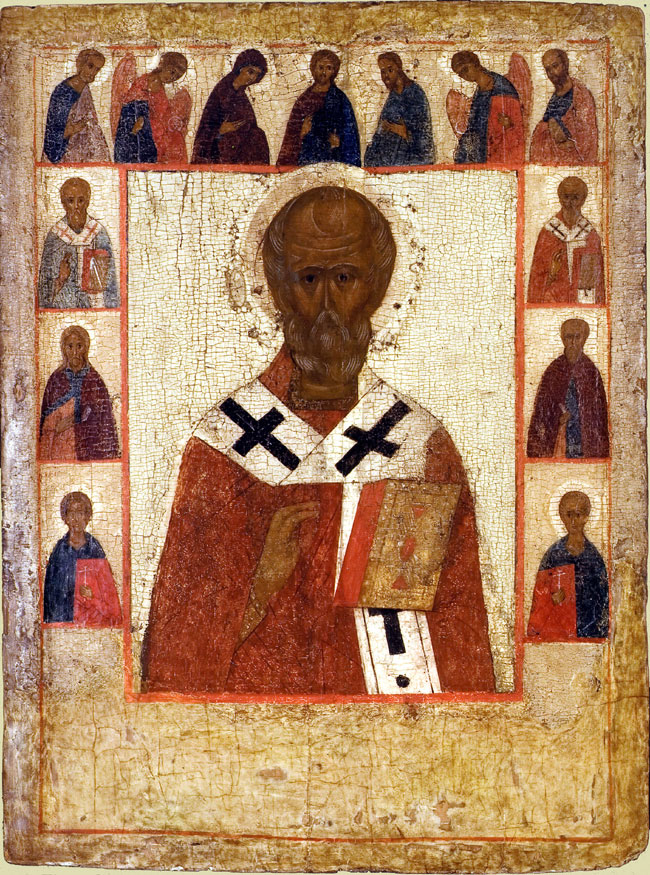
 SAINT NICHOLAS WITH DEESIS AND SAINTS
SAINT NICHOLAS WITH DEESIS AND SAINTS
Item number: 22
Egg tempera on wood
68.5 x 51 cm
Russia, Novgorod region, around 1500
Exposed white groundDepicted are Saints Peter, Paul, Blaise, Athanasius, Elijah, George, Demetrius, and a monk.
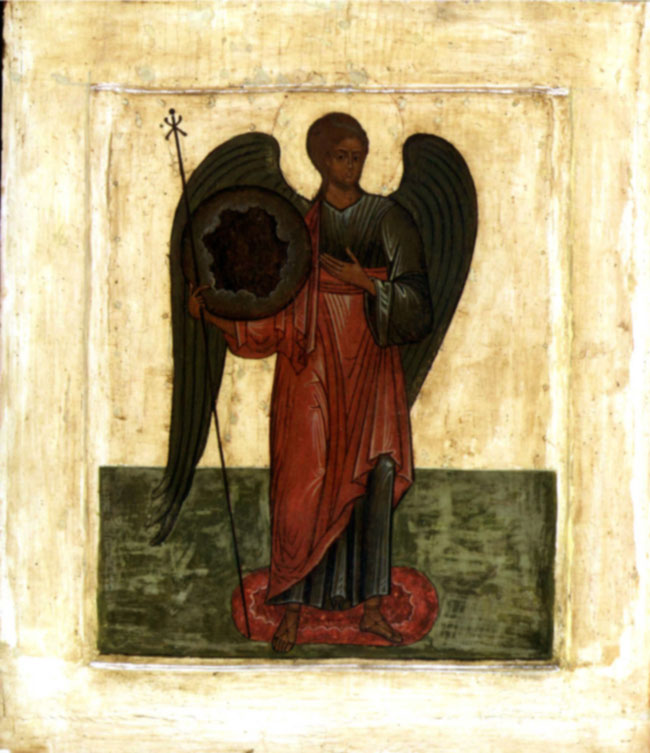 ARCHANGEL GABRIEL
ARCHANGEL GABRIEL
Item number: 259id
Egg tempera on wood
35.5 x 31 cm
Russia, 17th centuryExposed white ground
The Archangel Gabriel, the “strength of God,” carries out God’s commands and is one of the angels who stand before God. He is often depicted as a throne assistant, guardian at church portals, and protector against demons. He is the guardian of paradise. In his hands he holds the messenger’s staff and the mirror from which he reads God’s commands.
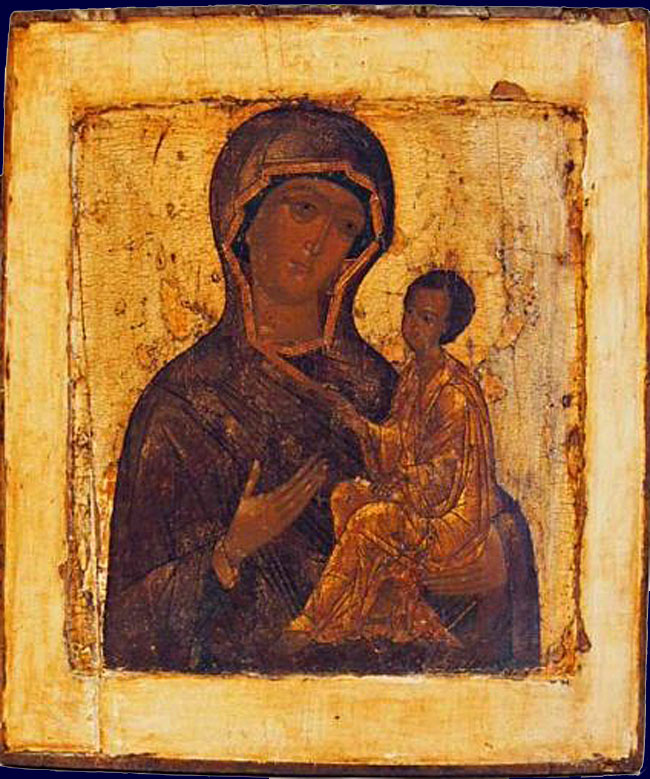 VIRGIN OF TICHWIN
VIRGIN OF TICHWIN
Item number: 372id
Egg tempera on wood
32 x 28 cm
Russia, 17th century
Exposed white groundThe feast of Our Lady of Tikhvin is celebrated on June 26. She is one of the most venerated Marian icons in Russia. According to legend, the original icon appeared in the 14th century floating on a cloud at the mouth of the Tikhvinka River, where a church was built at the site of the apparition. This was dedicated to the “Dormition of the Mother of God” and later became the main church of a monastery. The icon performed many miracles and healings and protected the monastery during the war. People prayed to her especially for the health of their children.
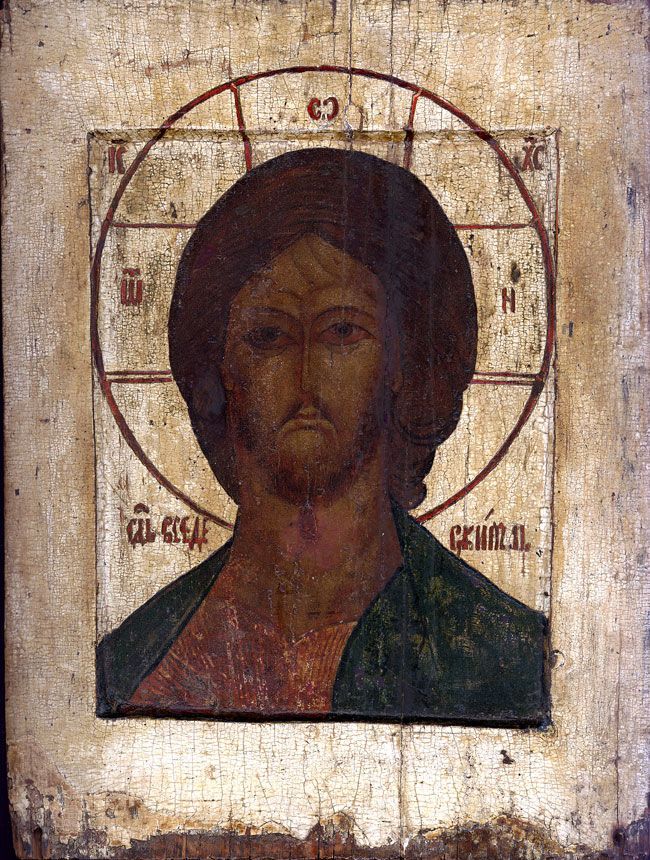 Christ the Grim Eye
Christ the Grim Eye
Item number: 15
Tempera on wood
38 x 30 cm
Russia, 16th century
Chalk ground
The depiction of “Christ the Grim Eye” belongs to the Pantocrator type. The name can be attributed to the stern gaze of the Savior’s eyes.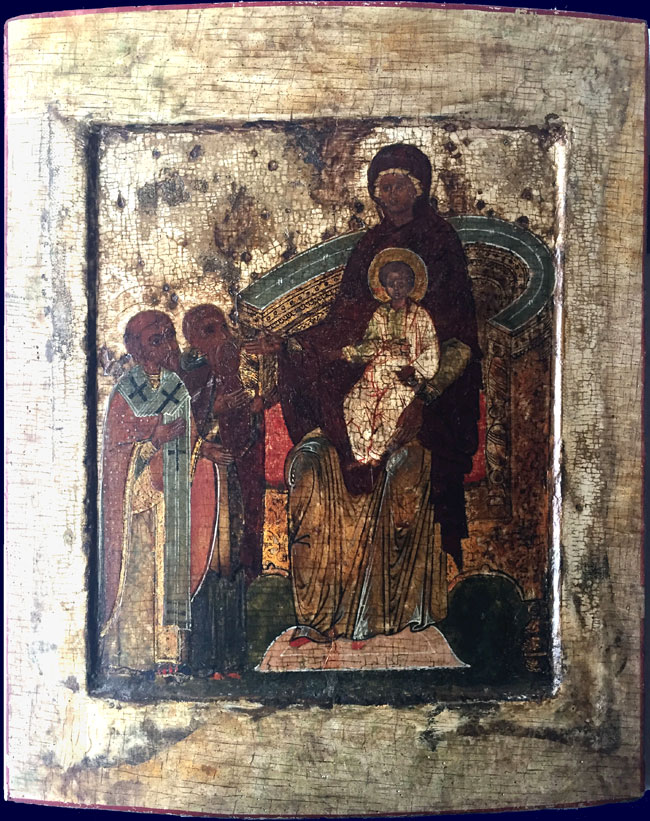 ENTHRONED MOTHER OF GOD
ENTHRONED MOTHER OF GOD
Item number: 387id
Tempera on wood,
30.5 x 26 cm
Russia, 17th century
Exposed white ground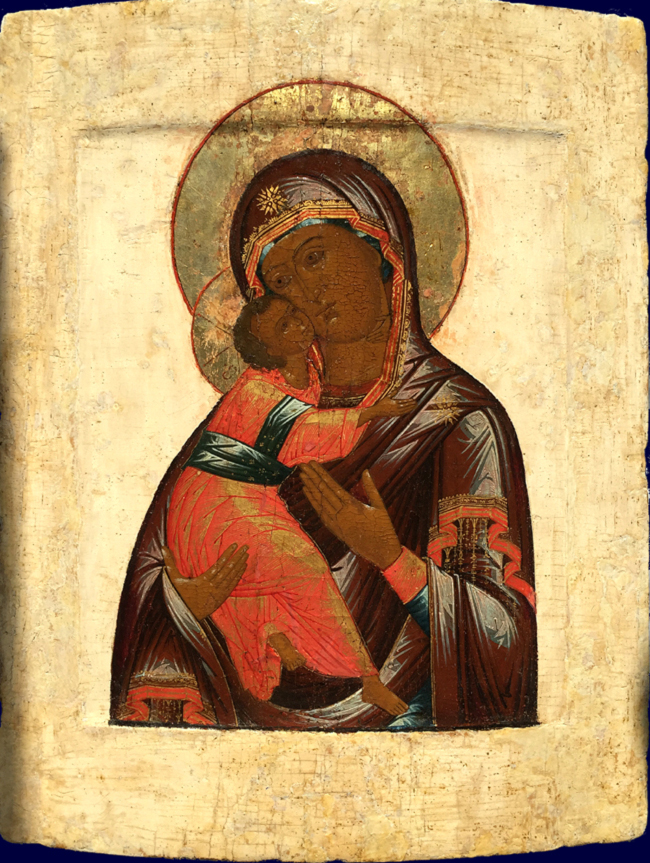 VIRGIN OF VLADIMIR
VIRGIN OF VLADIMIR
Item number: 394id
Egg tempera on wood
36 x 29 cm
Russia, 19th century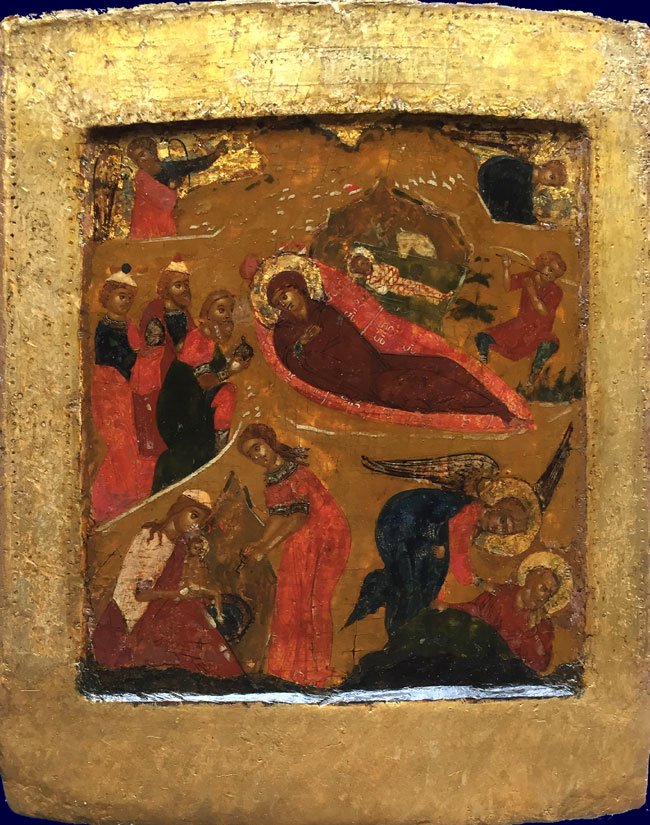 BIRTH OF CHRIST
BIRTH OF CHRIST
Item number: 448
Tempera on wood
32 x 27 cm
Russia, around 1600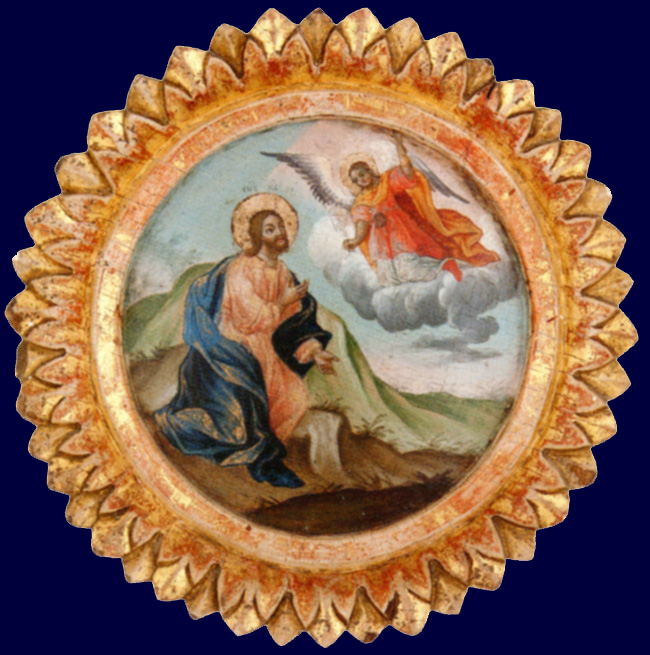 CHRIST IN THE GARDEN OF GETHSEMANE
CHRIST IN THE GARDEN OF GETHSEMANE
Item number: 322
Tempera on wood
Diameter 23.5 cmRussia, late 18th century
Sold
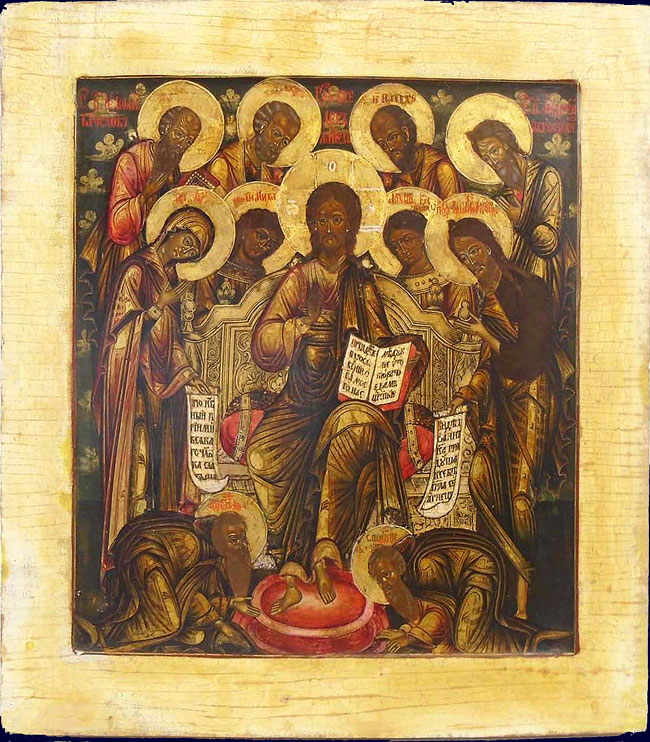 EXTENDED DEESIS
EXTENDED DEESIS
Item number: 439
Tempera on wood
30 x 28 cm
Russia, around 1800
The word “Deesis” is derived from the Greek word “Deein” (to beg, to pray) and goes back to a Marian legend which says that the Virgin Mary, together with John the Baptist, will beg the Judge of the World for mercy on the Day of Judgment. The enthroned Savior is framed by the Virgin Mary and John the Baptist in a supplicating posture, as well as the archangels Gabriel and Michael and Saints Andrew and John the Evangelist.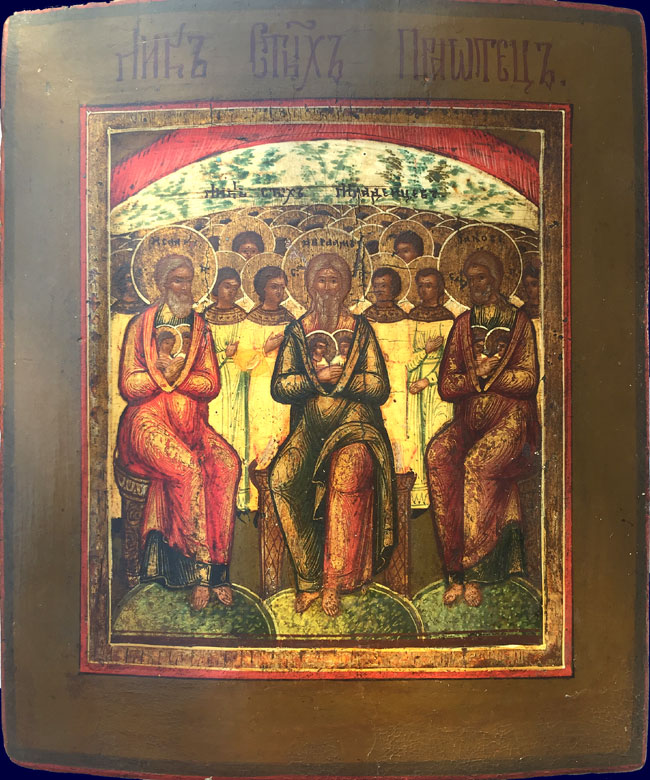 Abraham, Isaac, and Jacob in Paradise
Abraham, Isaac, and Jacob in Paradise
Item number: 452id
Tempera on wood
17.5 x 15 cm
Russia, 19th century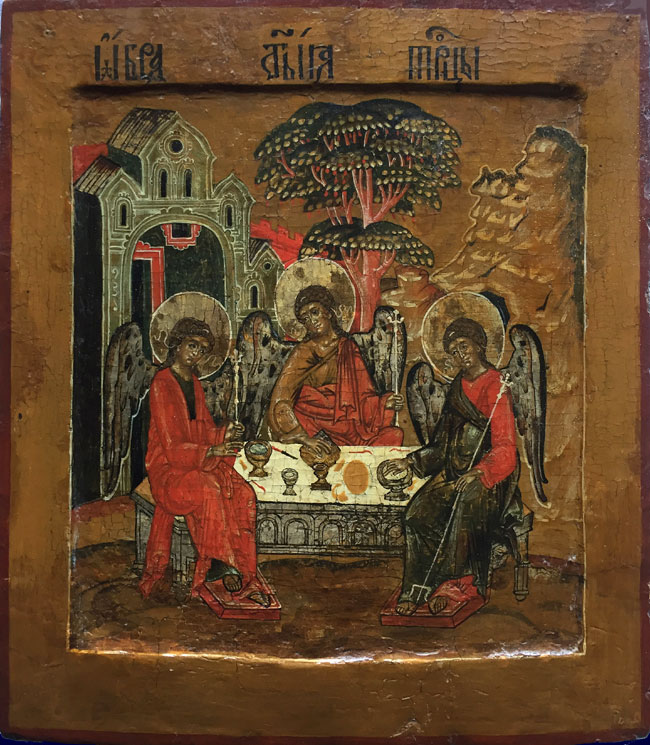 OLD TESTAMENT TRINITY
OLD TESTAMENT TRINITY
Item number: 438id
Tempera on wood,
31 x 28 cm
Russia, 18th century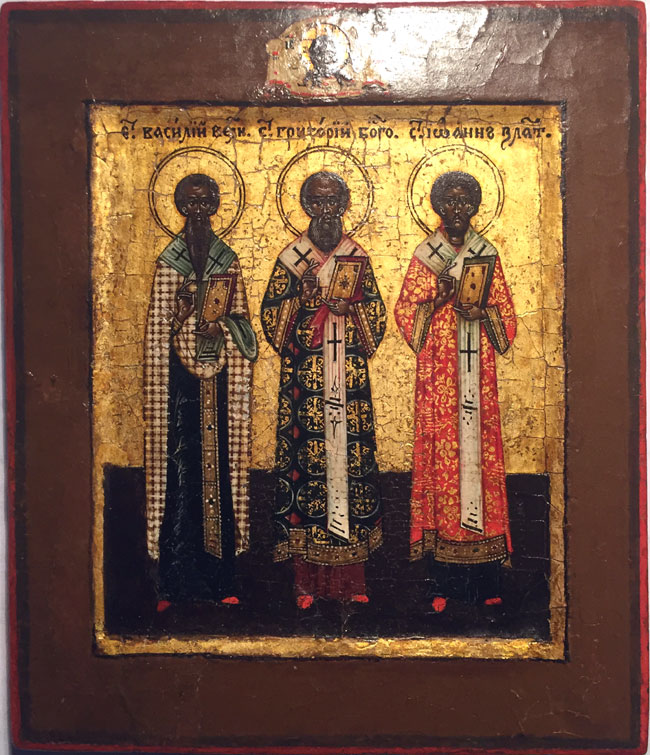 THREE SAINTS
THREE SAINTS
Item number: 443id
tempera on wood
21 x 17 cmRussian, 19th century
Depcted are the Saints Bailius the Great, Maron and Photina.
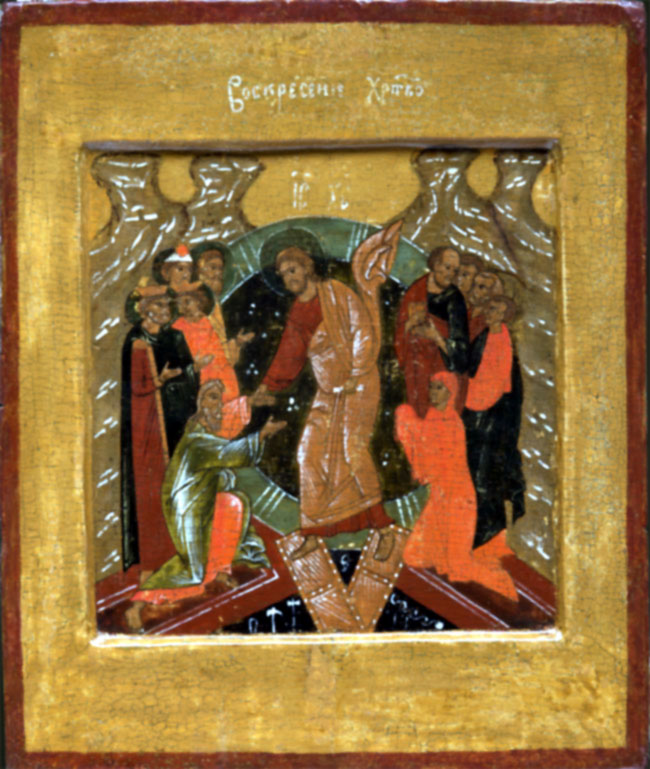 CHRIST'S DESCENT INTO HELL
CHRIST'S DESCENT INTO HELL
Item number: 295id
Egg tempera on wood,
31.5 x 26 cm
Russia, circa 1600
Christ—standing on the broken gates of hell—reaches out his hand to Adam as a symbol of the redemption of mankind.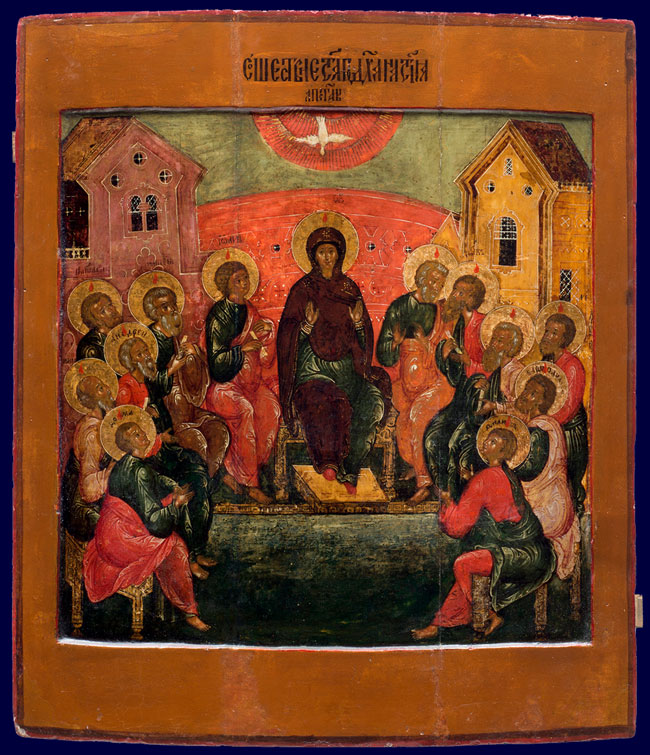 THE DESCENT OF THE HOLY SPIRIT
THE DESCENT OF THE HOLY SPIRIT
Item number: 340id
Tempera on wood,
72 x 61.5 cm
Russia, around 1700
And there appeared to them tongues as of fire, and they rested on each one of them. All were filled with the Holy Spirit. Acts 2:3-5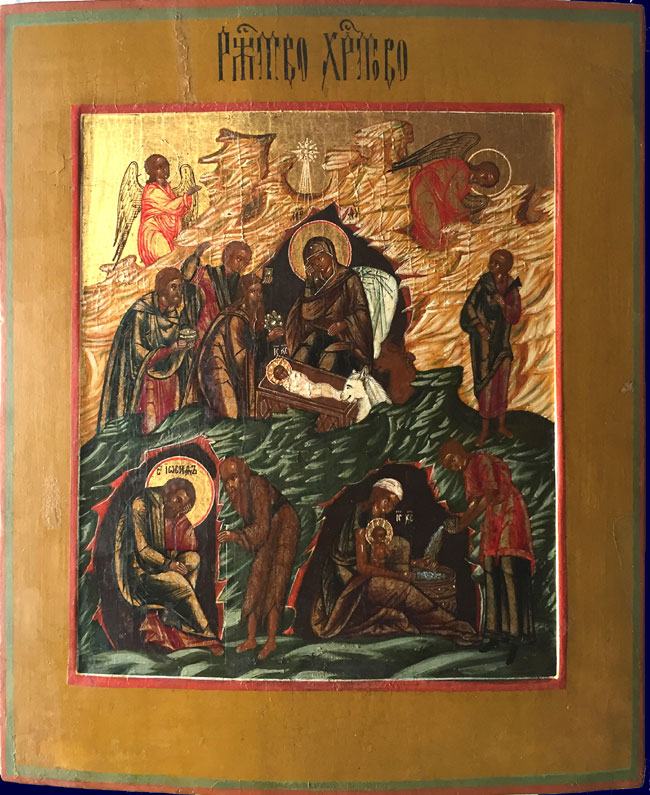 THE BIRTH OF CHRIST
THE BIRTH OF CHRIST
Item number: 401id
Egg tempera on wood
34.5 x 30 cm
Russia, 19th century
The center of the painting depicts the Virgin Mary with the baby Jesus in the manger before her. Kneeling in worship to her right are the three wise men from the East, while to her left a shepherd appears to whom an angel proclaims the good news. The lower part of the painting depicts “the temptation of Joseph” and the bathing scene. SAINT ELIAS
SAINT ELIAS
Tempera on wood
22 x 18 cm
Russian, 18th century
St. Nicholas is shown half length holding an open book of Gospels and delivering a blessing. In the upper half right and left are depicted Christ and Mary who are bringing him the gospelbook and the bishop’s omophorion – due to the legend- when he was in prison because of his faith.
On the borders:Guardian Angeland St. Catherine.
SOLD
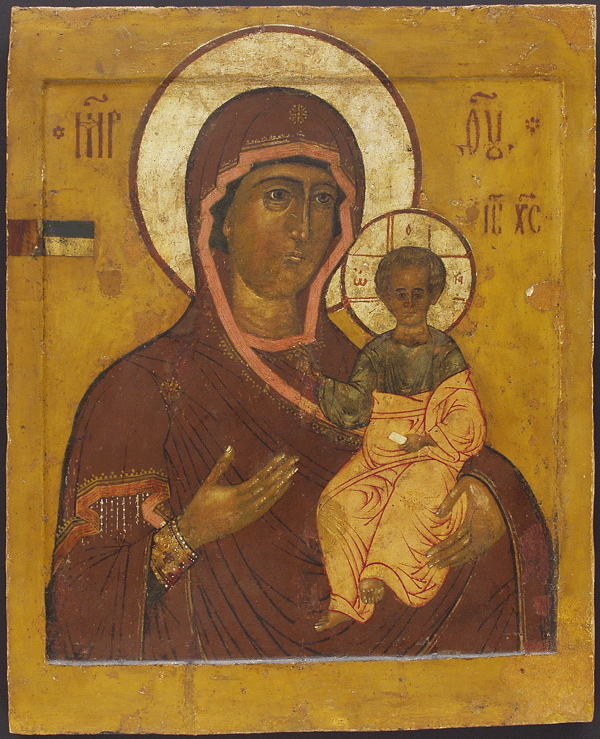 PPROCESSION ICON -VIRGIN HODIGITRIA
PPROCESSION ICON -VIRGIN HODIGITRIA
Item number: 44id
Tempera on wood,
55 x 45 cm
Russian, early 17th century
A both-sided painted cult image which was – mounted on a bar- carried like a standard in processions. Backside St.Nicholas.
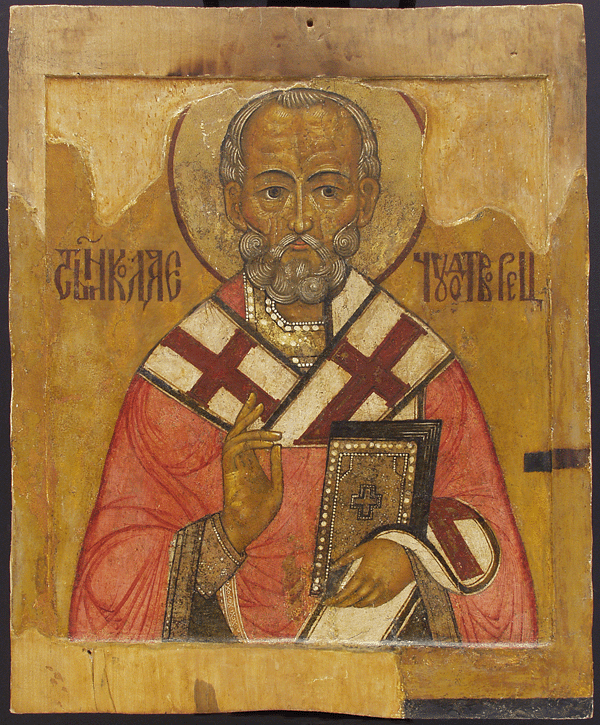 PROCESSION ICON ST. NICHOLAS
PROCESSION ICON ST. NICHOLAS
Item number: 44
Tempera on wood,
55 x 45 cm
Russian, early 17th century
A both-sided painted cult image which was – mounted on a bar- carried like a standard in processions.
 VIRGIN OF KASAN
VIRGIN OF KASAN
Item number: 371
Egg tempera on wood
31 x 25 cm
Russia, around 1800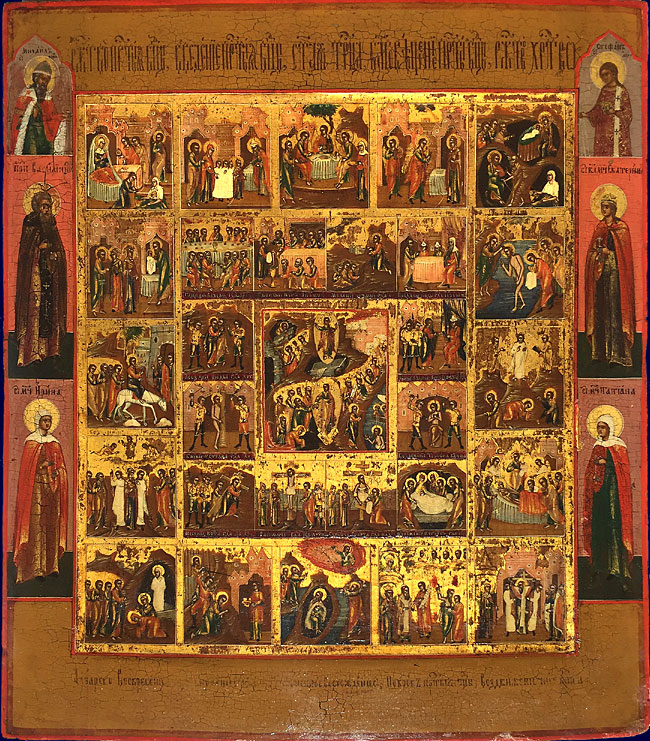 FEASTDAY ICON
FEASTDAY ICON
Item number: 368
tempera on wood
35,5 x 31 cm
Russian, early 19th century
In the center is depicted the Easter topic Christ’s resurection and descent to hell surrounded by sixteen solemnities of the Orthodox Church and twelve stations of His Passion
 VIRGIN FEDOROWSKAJA
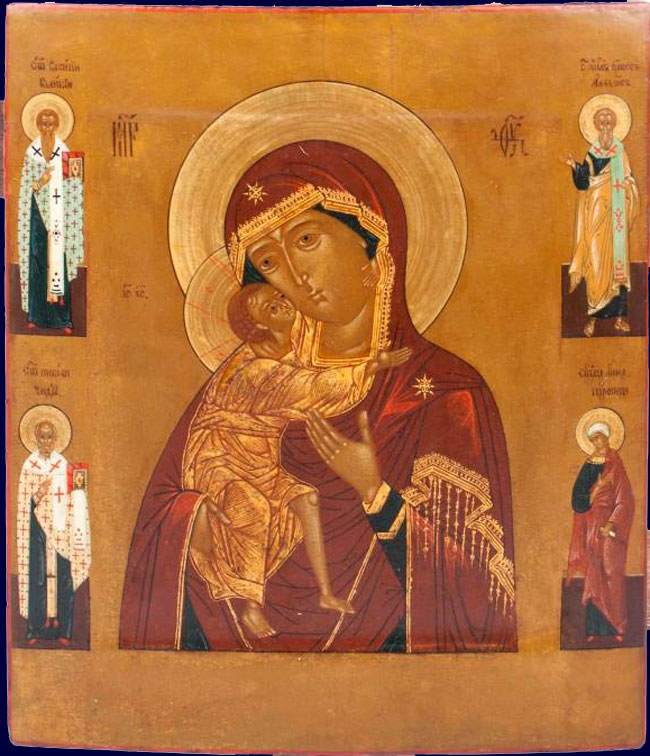
VIRGIN FEDOROWSKAJA
Item number: 373
Tempera on wood
31 x 27 cmRussia, around 1900
 ARCHANGEL MICHAEL COMMANDER OF THE ARMY
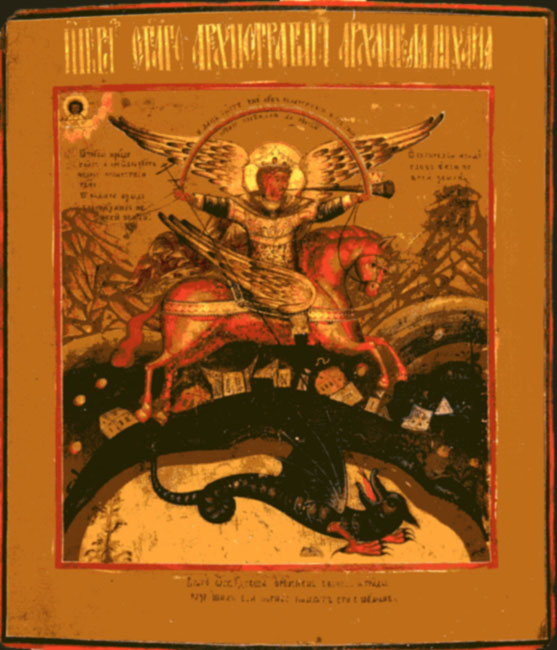
ARCHANGEL MICHAEL COMMANDER OF THE ARMY
Item number: 278
Tempera on wood
31 x 26.5 cmRussia, late 18th century
The Archangel Michael, whose Hebrew name means “Who is like God,” is the leader of the heavenly hosts and the guardian of paradise. He has been entrusted with special tasks by God: he brings the prayers of mankind to God, guides the souls of the deceased to paradise, and weighs souls on Judgment Day.
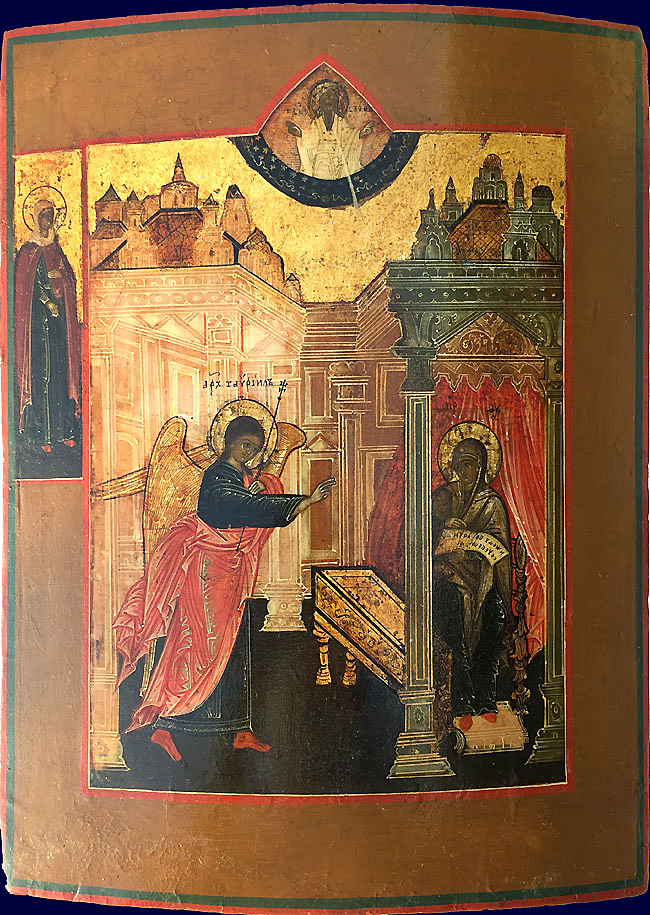 THE ANNOUNCEMENT
THE ANNOUNCEMENT
Item number: 445
Tempera on wood, gold ground
34 x 27 cmRussia, 19th century
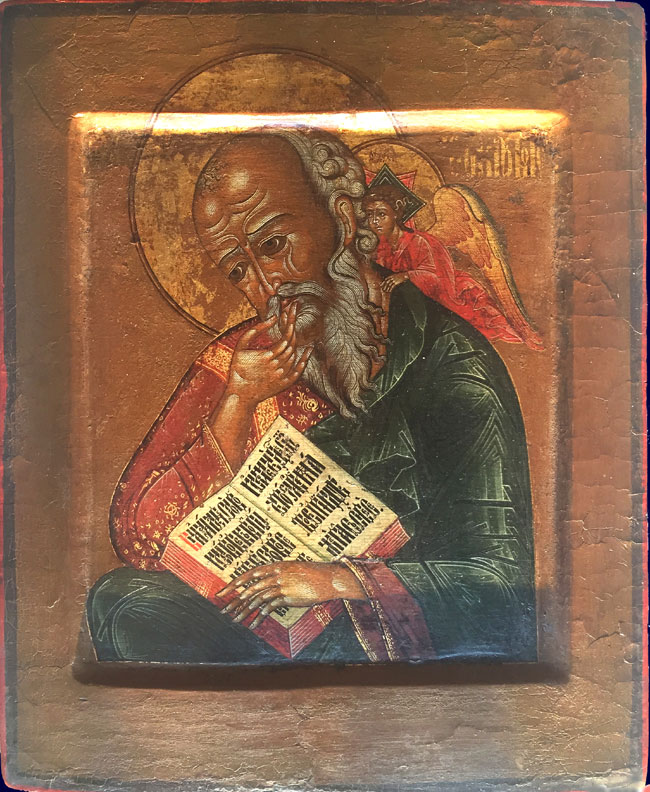 JOHN THE THEOLOGIAN
JOHN THE THEOLOGIAN
Item number: 389
Tempera on wood
31.5 x 26.5 cm
Russia, 18th century
Tradition equates the disciple John with the evangelist John, who is believed to have worked in Ephesus, where the Gospel of John and the three Epistles of John were written in the circle of his disciples.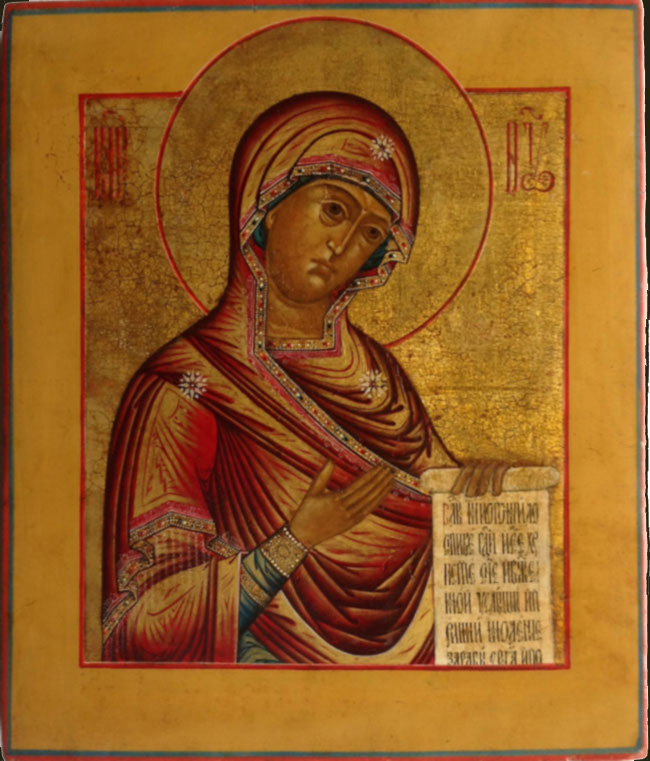 DEISIS TRIPARTITE
DEISIS TRIPARTITE
Item number: 309
Tempera on wood, gold ground
32 x 27 cmRussia, 19th century
 DEISIS TRIPARTITE
DEISIS TRIPARTITE
Item number: 309b
Tempera on wood, gold ground
32 x 27 cm
Russia, 19th century
The theme is derived from the Greek word “deein” = to ask, to pray, and means that on the Day of Judgment, the Mother of God and John the Baptist will intercede with Christ for the souls of the lost. At the same time, it signifies the universal intercession of all the saints in their choirs for the world, as well as the vision of heavenly glory in the coming eon.
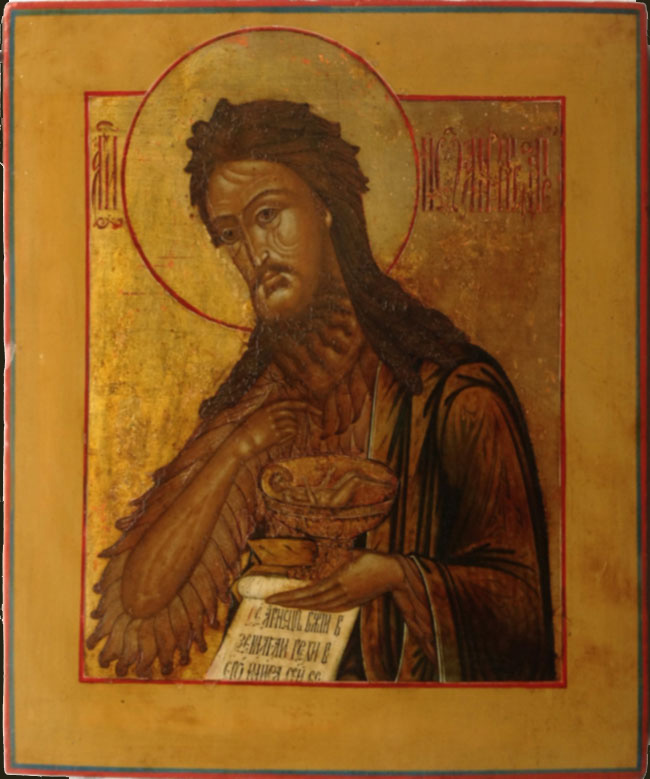 DEISIS TRIPARTITE
DEISIS TRIPARTITE
Item number: 309c
Tempera on wood, gold ground
32 x 27cm
Russia, 19th century
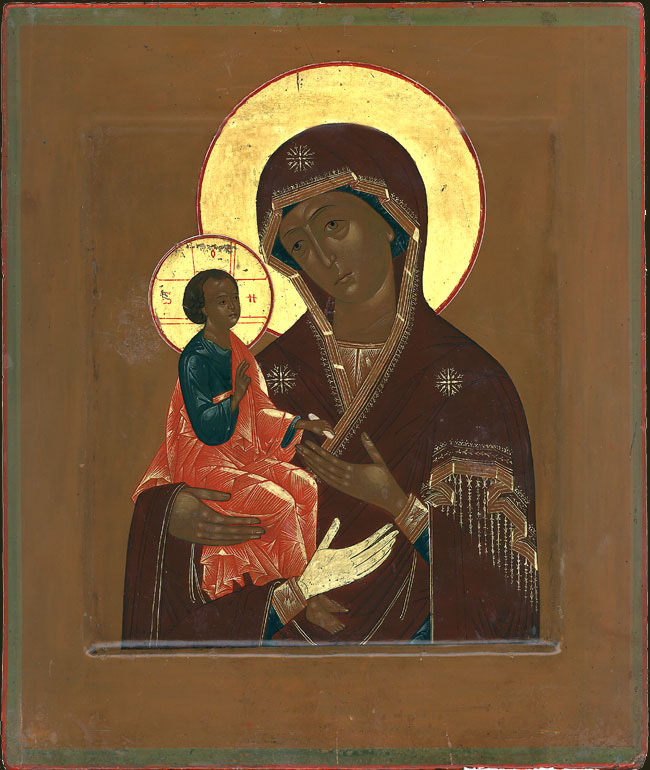 MOTHER OF GOD TRICHERUSA
MOTHER OF GOD TRICHERUSA
Item number: 50id
Egg tempera on wood,
31 x 26.5 cm
Russia, 19th century
The original icon of the three-handed Mother of God is located in the Serbian monastery of Hilandari on Mount Athos. According to legend, St. John of Damascus had his right hand chopped off after being slandered. After praying to the Mother of God, she allowed his hand to grow back while he slept. Out of gratitude, John had a silver hand made and attached it to the icon of Mary as a third hand.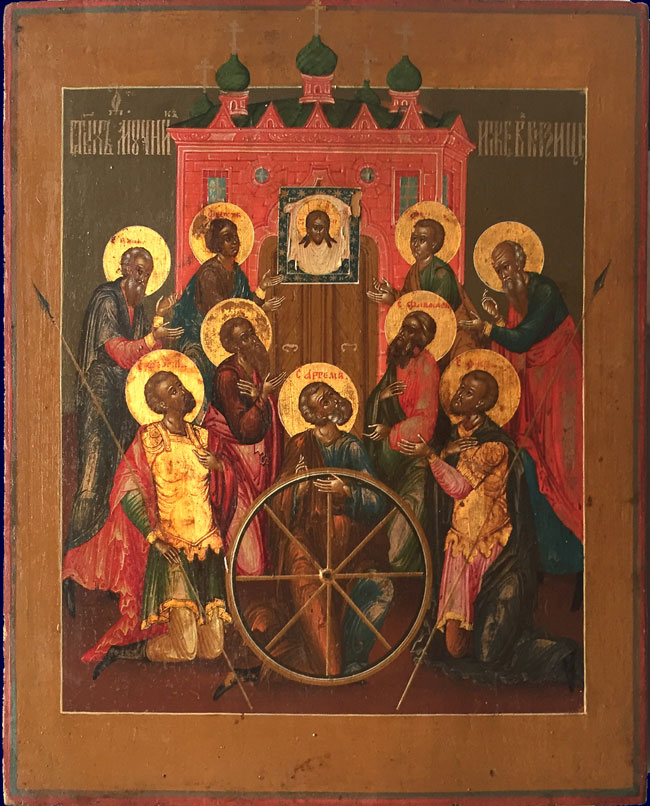 NINE MARTYRS OF KYZZIKOS
NINE MARTYRS OF KYZZIKOS
Item number: 384
Egg tempera on wood
31.5 x 28.5 cm
Russia, around 1800
The nine Christians—Theognides, Ruphos, Antipater, Theostichos, Artemon, Magnos, Theodotos, Thaumasios, and Philemon—who openly proclaimed their faith and denounced the pagan religion in the pagan city of Kyzikos in the 3rd century were beheaded.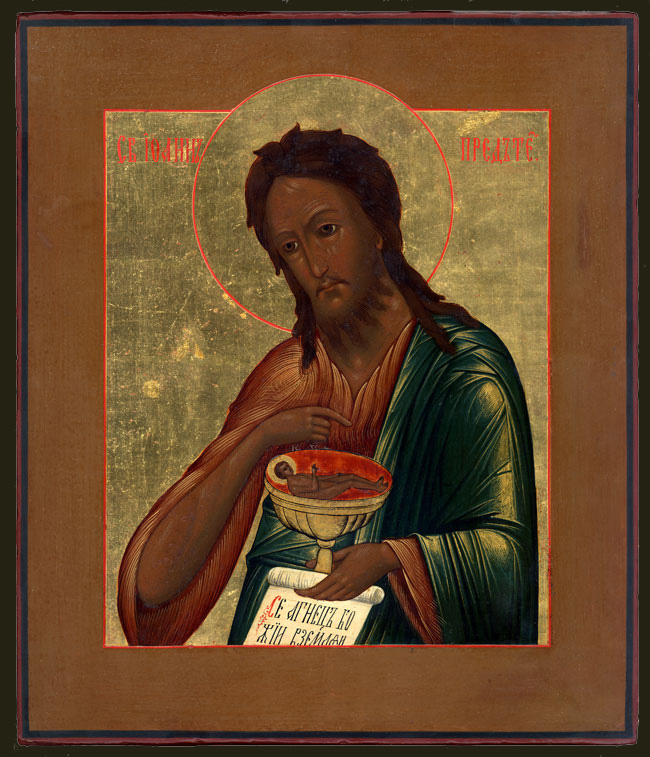 SAINT JOHN THE BAPTIST
SAINT JOHN THE BAPTIST
Item number: 43id
Egg tempera on wood,
31 x 26.5 cm
Russia, 19th century
According to tradition, John, son of Elizabeth and Zacharias, was born six months before Jesus. In the year 28, he first appeared in public as a preacher of repentance. He lived as an ascetic in the desert, where he wore camel hair and fed on locusts and wild honey. He proclaimed the coming of the Messiah longed for by the Jews and, in preparation for this, performed the baptism of repentance in the Jordan River with water as a symbol of salvation in the coming Last Judgment.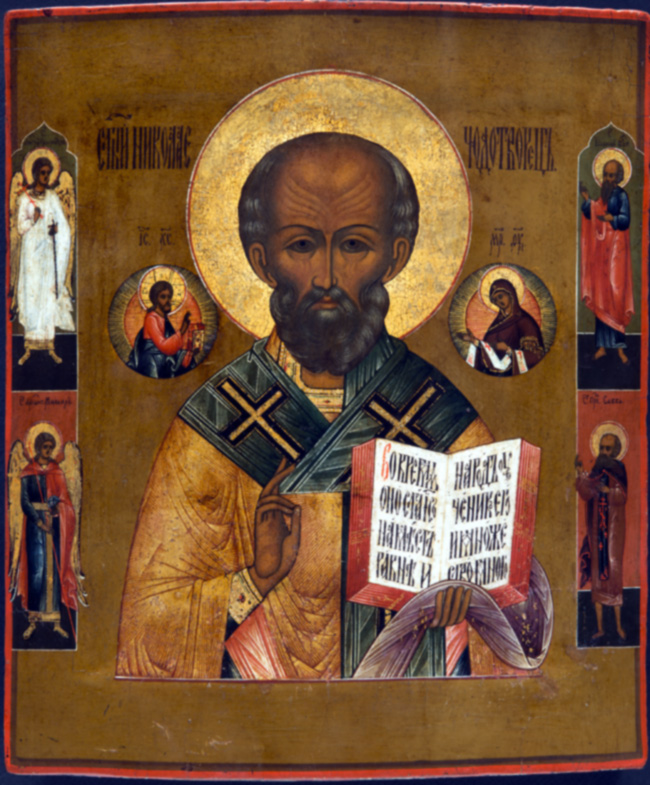 SAINT NICHOLAS
SAINT NICHOLAS
Item number: 246
Tempera on wood
35 x 31 cm
Russia, early 19th centurySaint Nicholas, bishop of Myra in the 6th century, is undoubtedly the most revered saint in the Orthodox Church and one of the saints who is equally venerated in the West. Image border: Guardian angel, Michael, John, Savas.
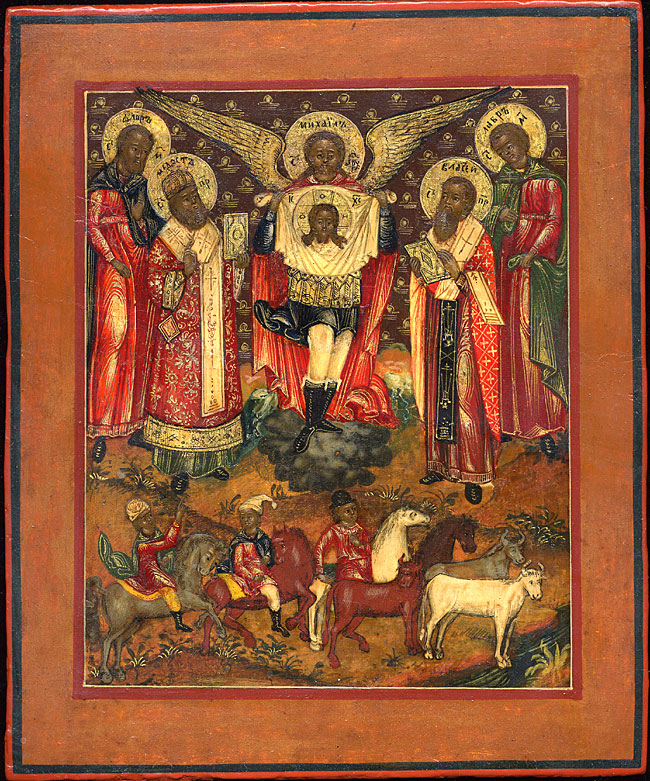 SAINTS FLORUS, LAURUS, AND MODESTUS
SAINTS FLORUS, LAURUS, AND MODESTUS
Item number: 148
Tempera on wood
22 x 18 cm
Russia, 19th century
Depicted are Saints Florus and Laurus, the special protectors of horses, and Saints Vlasy and Modestus. In the lower part of the picture are the three Cappadocian horsemen Pevsipp, Elasipp, and Messip (“horse scout,” “horse trainer,” and “catcher of noble black horses”) with herds of horses at the watering hole.
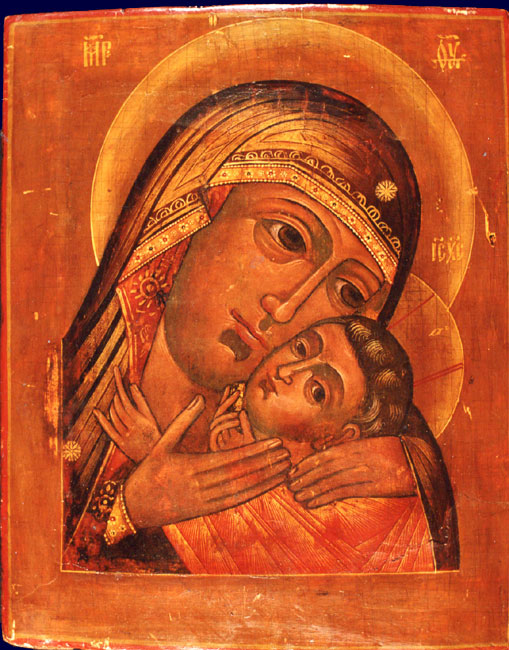 VIRGIN OF KORSUM
VIRGIN OF KORSUM
Item number: 414
Egg tempera on wood
31 x 27 cm
Russia, 19th centuryAccording to legend, Prince Vladimir brought the icon from Cherson in Crimea to Kiev at the end of the 1st millennium. Later, it was taken to the Cathedral of the Dormition of the Mother of God in Moscow. It is a variant of the Eleousa or Umilenie icons, depicting the tender, merciful Mother of God. The feast of the miraculous icon is celebrated on October 9.
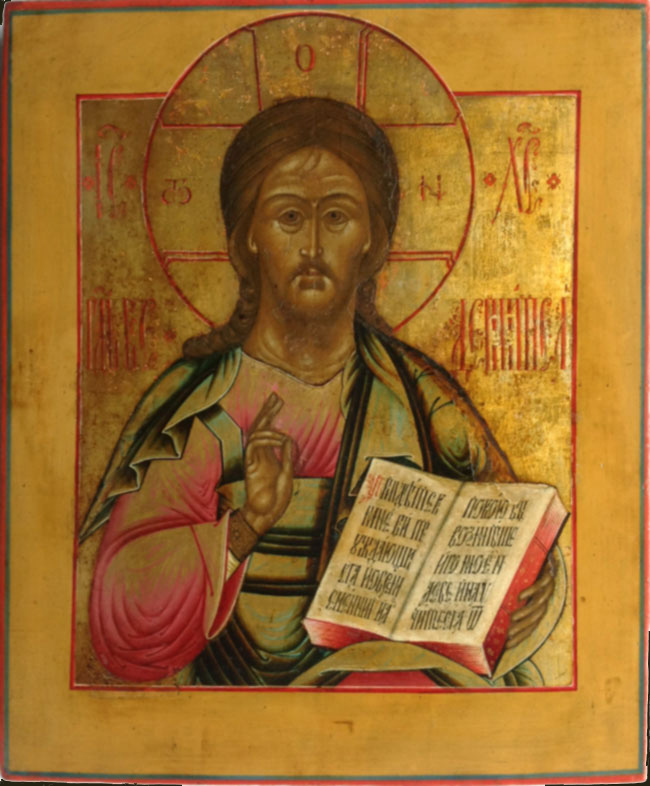 CHRIST THE GRIMME EYE
CHRIST THE GRIMME EYE
Item number: 229
Russia, 19th century
Tempera on wood
31 x 26.5 cm
Russia, 19th century
The depiction of “Christ the Grim Eye” belongs to the Pantocrator type.
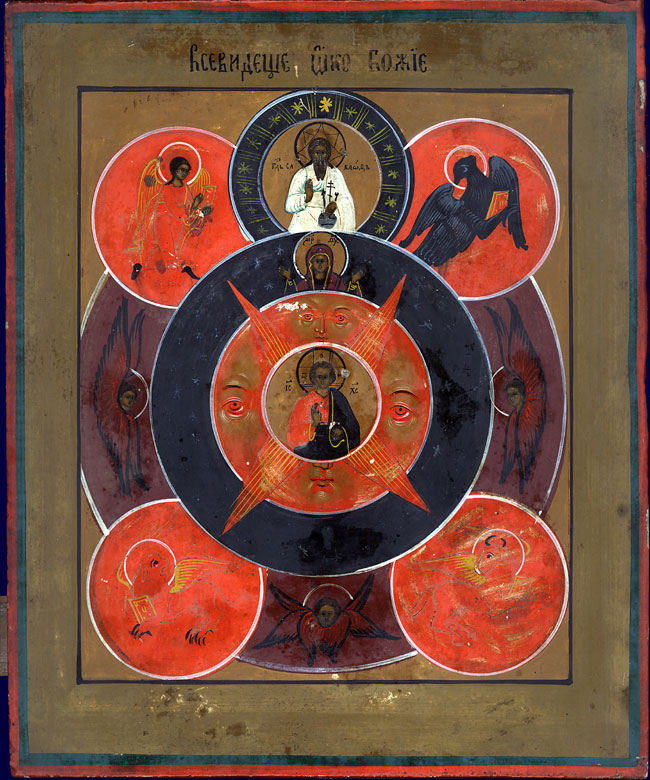 THE ALL SEEING EYE OF GOD
THE ALL SEEING EYE OF GOD
Item number: 128
Tempera on wood
31 x 26 cm
Russia, 19th century“These are the seven eyes of the Lord, which range throughout the whole earth.” Zechariah 4:10
An outer circle of cherubim and an inner circle of stars enclose a face, in the center of which, between the eyes, Christ as a boy is depicted in another circle resting on a four-pointed star. Above this, in the inner circle, the Mother of God is depicted in a praying posture. Around the outer circle are five smaller circles, in which God the Father appears in the upper center of the picture and the symbols of the evangelists John, Luke, Mark, and Matthew appear in the other four.
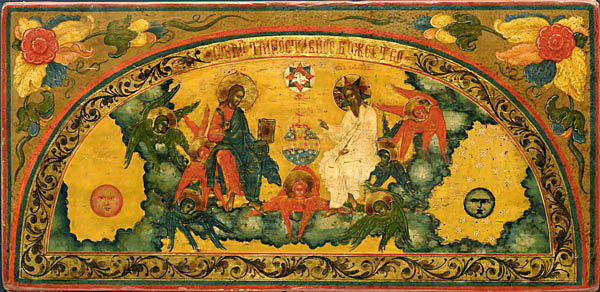 THE NEW TESTAMENT TRINITY
THE NEW TESTAMENT TRINITY
Item number: 171id
Tempera on wood,
18 x 39 cm
Russia, ca. 1800God the Father and God the Son are enthroned on clouds and surrounded by cherubim. Between them, above the globe on which the cross rises, flanked by the lance and the hyssop rod, the Holy Spirit hovers in the form of a dove. The sun and moon are on the right and left.
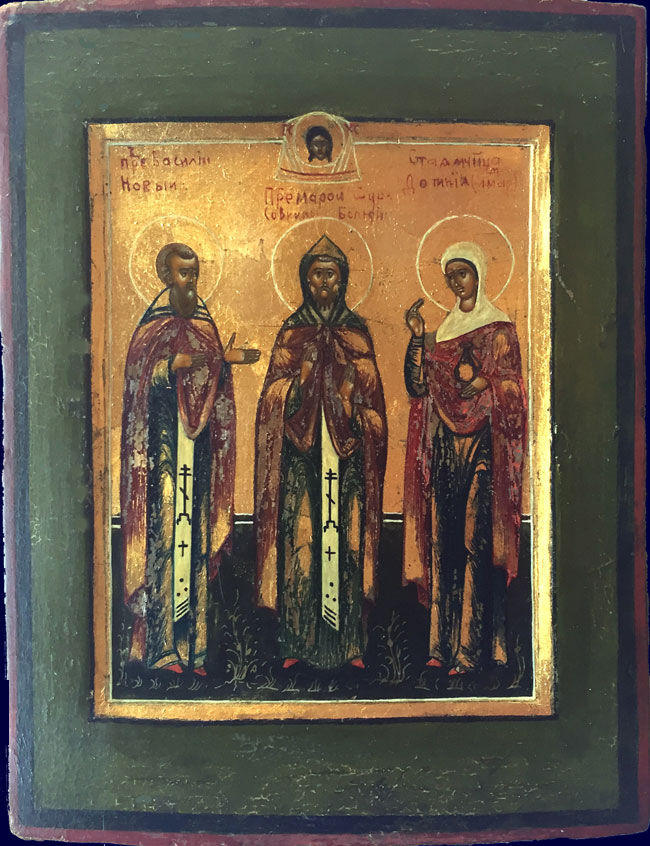 THREE SAINTS
THREE SAINTS
Item number: 354id
Tempera on wood
21 x 17 cm
Russia, 19th century
Depicted are Saints Basil the Great, Maron, and Photina.
 OLD TESTAMENT TRINITY
OLD TESTAMENT TRINITY
Item number: 35
tempera on wood
31 x 26 cm
Russian, 19th century
Generally speaking the three persons of the Trinity are not distinguished by inscriptions, however some understood them thusly: Christ at center, above whom is a tree, signifying the wood of the cross, God the Father at left, before a building symbolizing the Church, and the Holy Spirit on the right, below a hill signifying spiritual ascent.
 THREE MOSCOW PATRIARCHS
THREE MOSCOW PATRIARCHS
Item number: 73
ALEXIUS PETER AND JONA
RANDHEILIGE JOHANNES AND NIKITATempera on wood
31 x 27 cm
Russia, around 1800
The joint feast day of the three metropolitans and miracle workers of all Russia – Alexius (February 12), Peter (December 21), and Jonah (March 31) – the protector and intercessor of the city of Moscow, is celebrated on October 5.
Image margin: John and Nikita
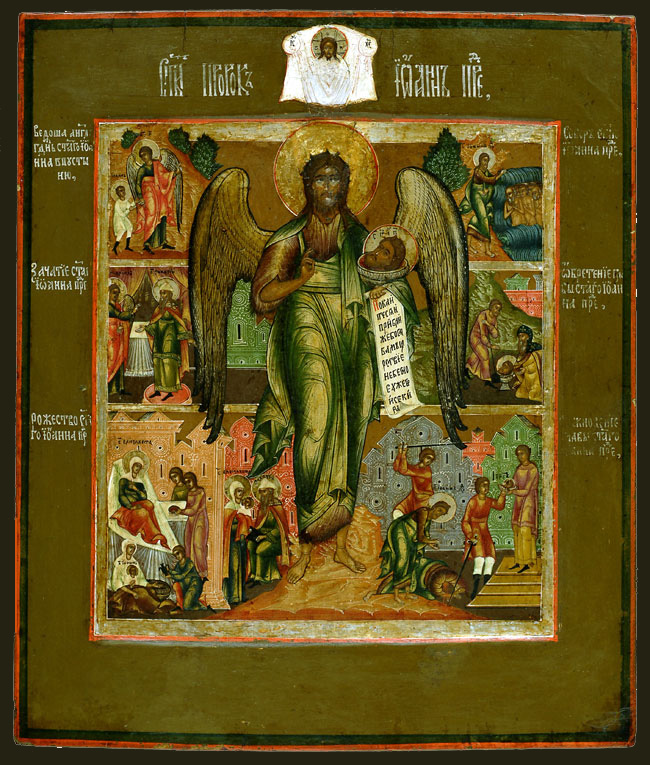 JOHN'S VITA
JOHN'S VITA
Item number: 154
JOHANNES VITA
Tempera on wood
31 x 26.5 cm
Russia, 19th centuryIn the center of the picture stands Saint John, holding a bowl with his head in his hand. He is surrounded by eight scenes from his life story: the archangel Uriel leading the boy John into the desert, John praying in the desert, the archangel Gabriel announcing the birth of John to Zacharias, the second discovery of John’s head, the birth of John, his parents Zacharias and Elizabeth with the child John, the beheading of John, and the presentation of his head to Salome.
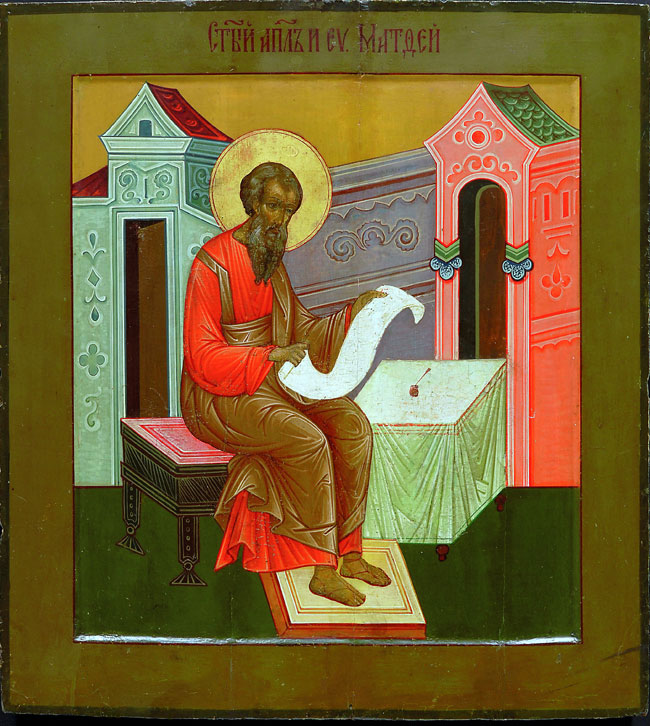 EVANGELIST MATTHEW
EVANGELIST MATTHEW
Item number: 70
Tempera on wood
56 x 48 cm
Russia, 19th century
After being called by Jesus to become one of his apostles, Levi, son of Alphaeus from Capernaum, was given the nickname Matthew and wrote the first Gospel before 70 AD. His later life and death are legendary and partly intertwined with the life of Matthias. He is the patron saint of the city and diocese of Salerno (Italy) and was also chosen as patron saint by tax collectors, customs officers, accountants, and drinkers.
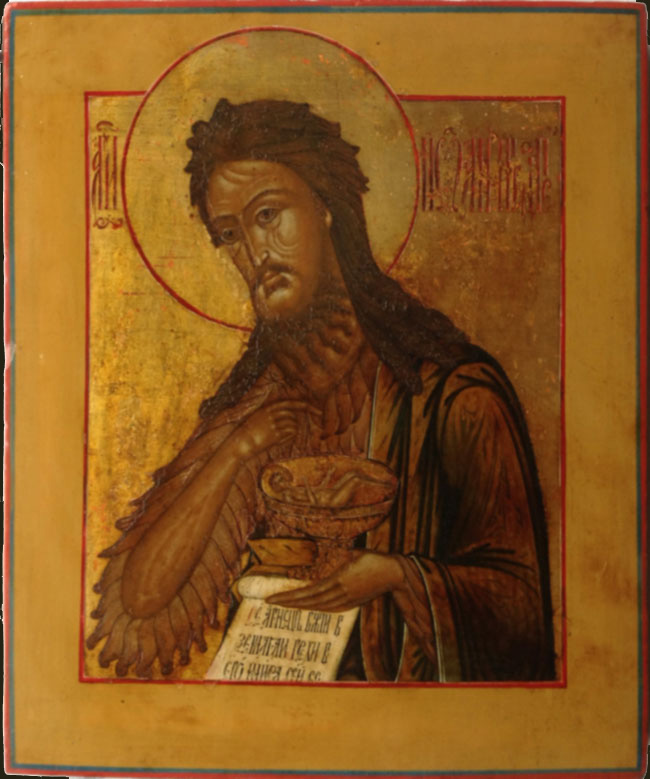 SAINT JOHN THE BAPTIST
SAINT JOHN THE BAPTIST
Item number: 298
Tempera on wood
28 x 23 cm
Russia, 17th century
According to tradition, John, son of Elizabeth and Zacharias, was born six months before Jesus. In the year 28, he first appeared in public as a preacher of repentance. He lived as an ascetic in the desert, where he wore camel hair and fed on locusts and wild honey.
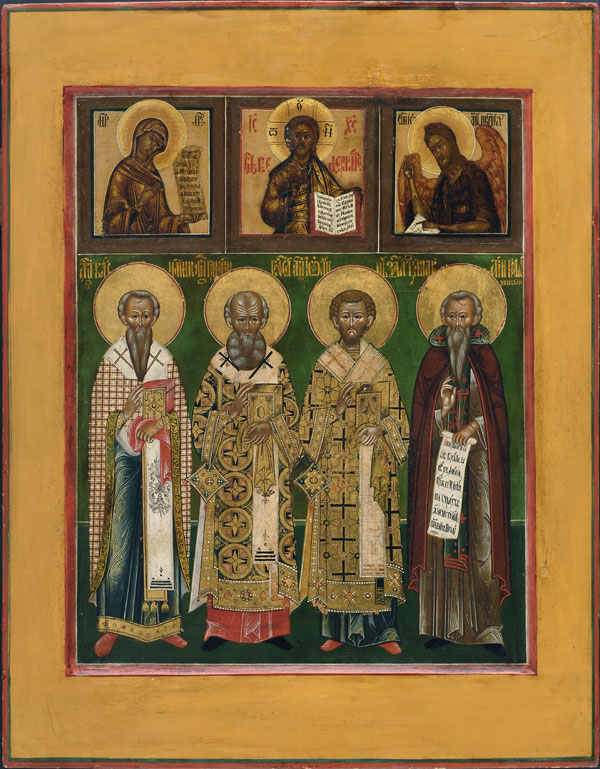 FOUR SAINTS AND DEESIS
FOUR SAINTS AND DEESIS
Item number: 169
Tempera on wood
45 x 35 cm
Russia, 19th centuryDepicted are Saints Basil the Great, Gregory of Nazianzus, John Chrysostom and Markarius, with the Deesis in the upper part of the painting.
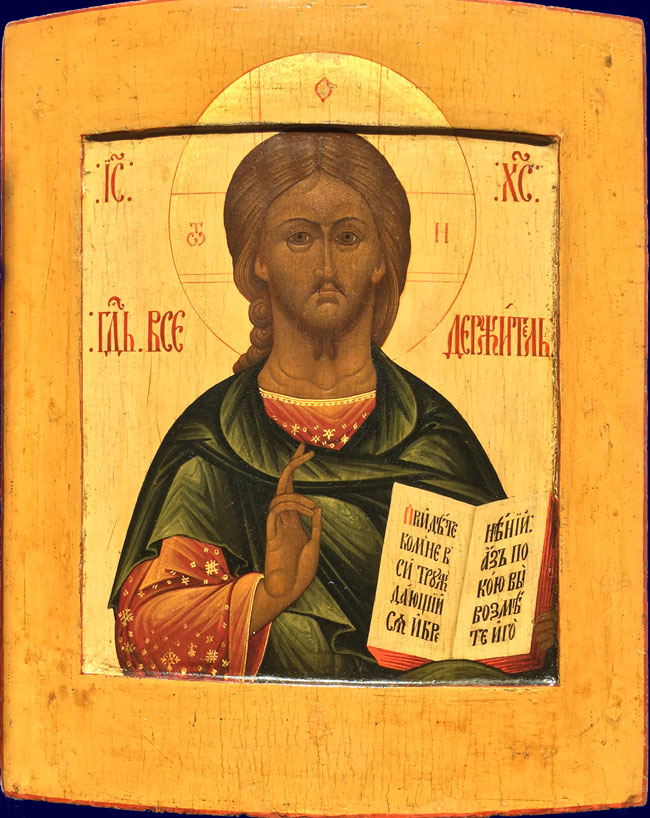 CHRISTUS PANTOCRATOR
CHRISTUS PANTOCRATOR
Item number: 394
Tempera on wood
31 x 27 cm
Russia, around 1800The open page of the Gospel book usually quotes John 8:12: “I am the light of the world. Whoever follows me will never walk in darkness, but will have the light of life.”
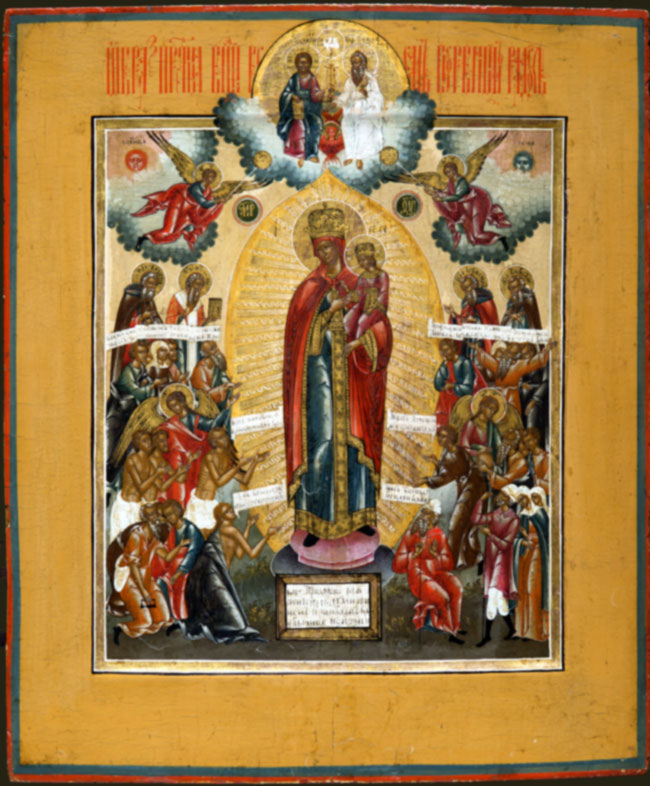 Mother of God, Joy of All Who Suffer
Mother of God, Joy of All Who Suffer
Item number: 218
Tempera on wood, gold
36 x 30.5 cm
Russia, 19th century
In the center of the painting is the Virgin Mary in a mandorla. The baby Jesus rests on her left arm. Above her is the Trinity from the New Testament. On either side of her are groups of sick, poor, hungry, and thirsty people who are led to her by angels to beg for her intercession. In the upper left and right corners of the painting are the sun and moon.
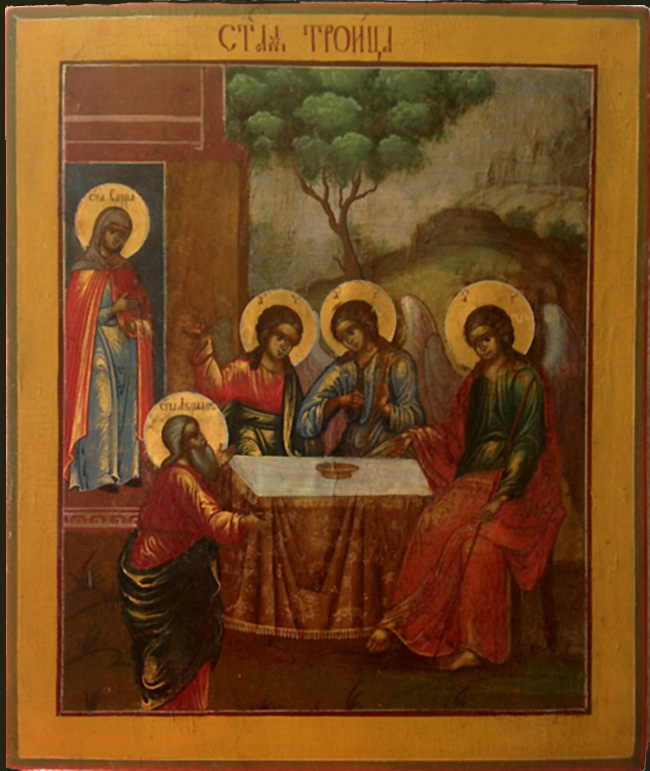 OLD TESTAMENT TRINITY
OLD TESTAMENT TRINITY
Item number: 320
Tempera on wood
31 x 27 cm
Russia, 19th centuryThe three angels, symbolizing God the Father in the center, Christ on the left, and the Holy Spirit on the right, are gathered around the table, framed by Abraham and Sarah. In the foreground, a servant slaughters a calf for the feast, while in the background, the oak tree of the grove rises.
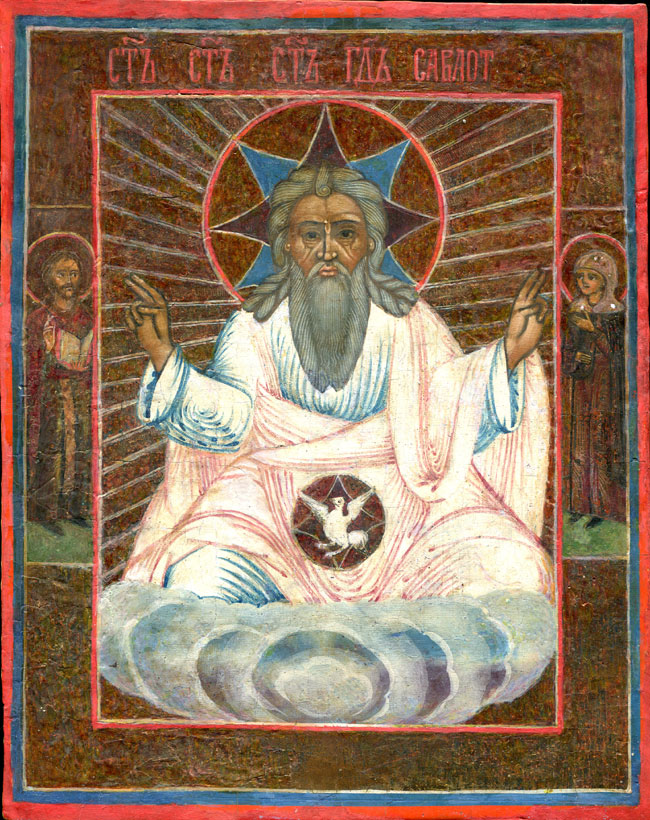 GOD THE FATHER
GOD THE FATHER
Item number: 355
Tempera on wood, gold ground
23 x 18 cm
Russia, 19th century
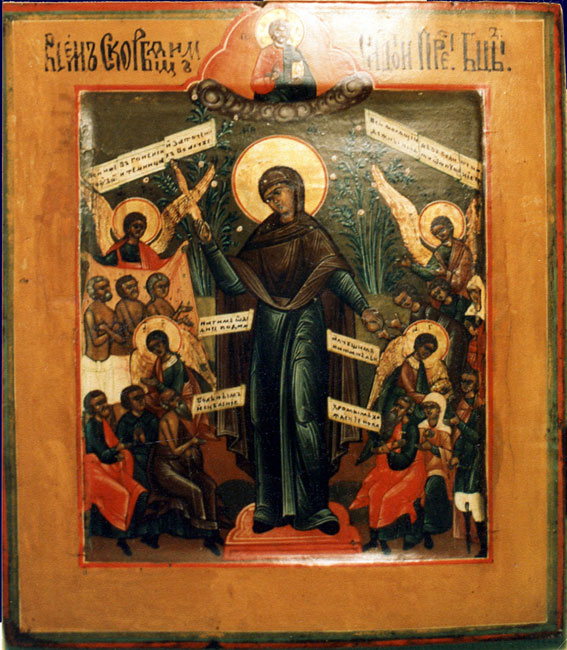 Mother of God, Joy of All Who Suffer
Mother of God, Joy of All Who Suffer
Item number: 415
Tempera on wood
31 x 26 cm
Russia, 19th century
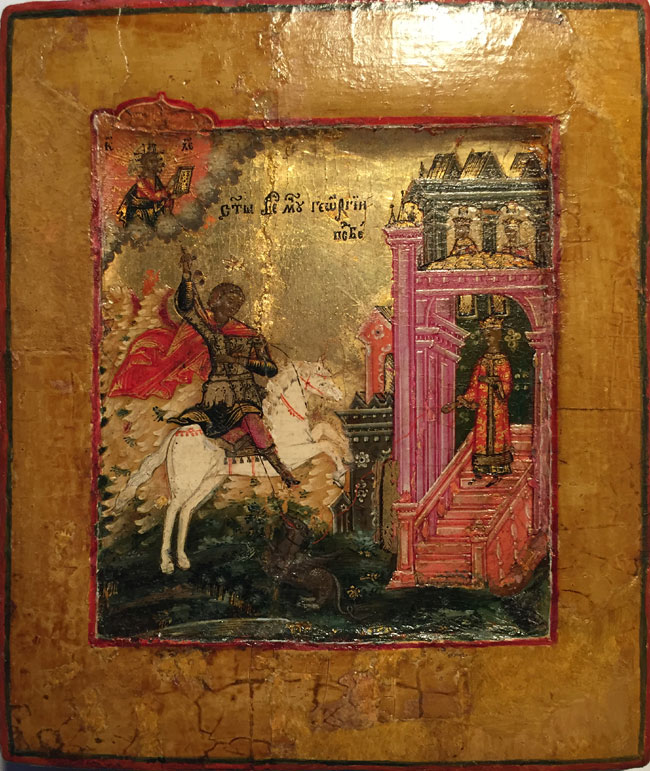 SAINT GEORGE
SAINT GEORGE
Item number: 450
Egg tempera on wood
13 x 11 cm
Russia, 19th century HOLY APOSTLE SIMEON
HOLY APOSTLE SIMEON
Item number: 151
Tempera on wood
55 x 31 cm
Russia, around 1800The icon probably originates from a smaller iconostasis.
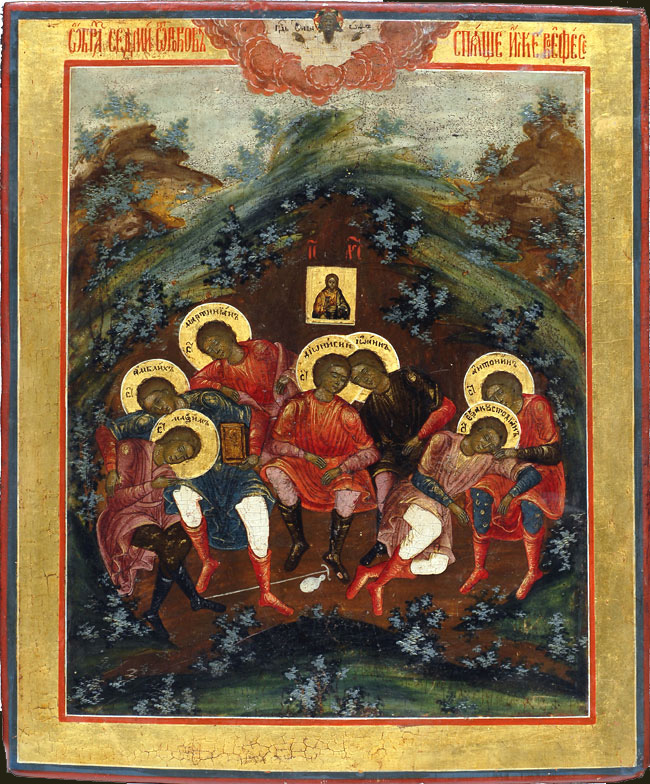 THE SEVEN SLEEPERS OF EPHESUS
THE SEVEN SLEEPERS OF EPHESUS
Item number: 77
Tempera on wood
31 x 26 cm
Russia, 19th century
The seven shepherd boys, who were persecuted under Decius because of their faith, fled to a cave near Ephesus, where they were walled in. They slept there for almost 200 years before they were found and awakened again.
 CHRISTUS PANTOCRATOR
CHRISTUS PANTOCRATOR
Item number: 113
Tempera on wood
35.5 x 31 cm
Russia, 19th century
Christ Pantocrator – the ruler of the world – is depicted in half-length. His right hand is raised in a gesture of blessing, while in his left hand he holds the Gospel book (a reference to the proclaimer of eternal truth).
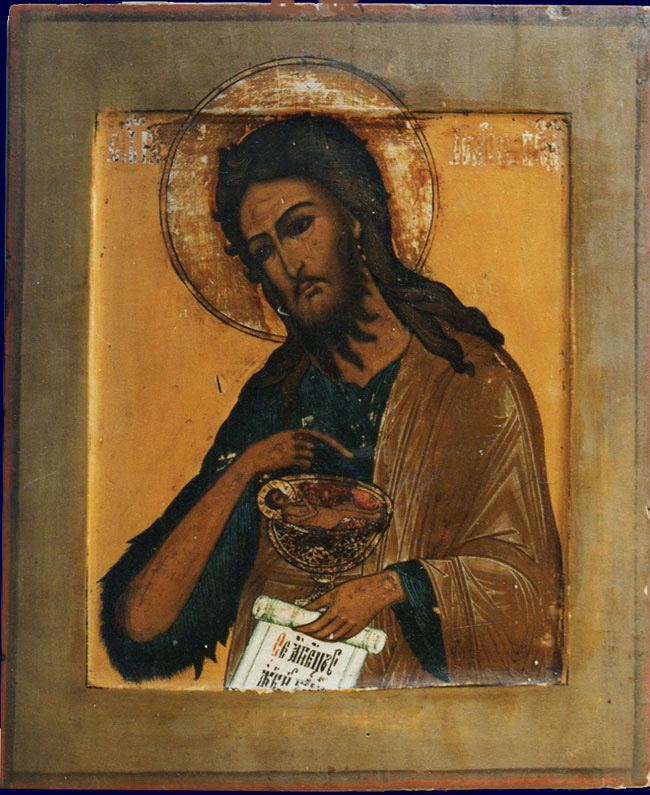 JOHN THE BAPTIST
JOHN THE BAPTIST
Item number: 405
Tempera on wood
31.5 x 27 cm
Russia, around 1800
 JOHN THE EVANGELIST
JOHN THE EVANGELIST
Item number: 71
Tempera on wood
30.5 x 27 cm
Russia, late 18th century
Saint John has placed the fingers of his right hand on his lips in a gesture of silence. Above his shoulder appears an angel, symbolizing the Holy Spirit imparting the Gospel to him.
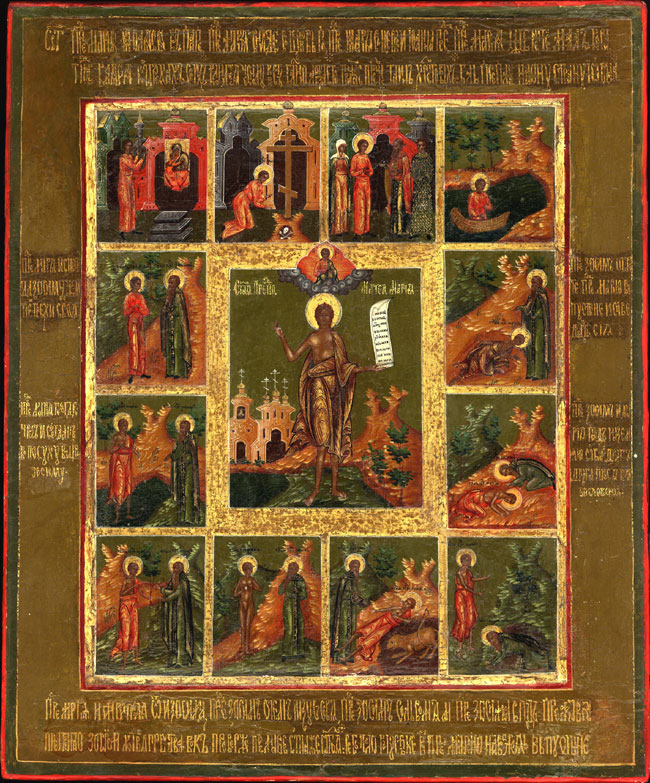 MARY OF EGYPT WITH VITA
MARY OF EGYPT WITH VITA
Item number: 90
Tempera on wood
31 x 26 cm
Russia, early 19th century
In the center of the painting, the saint is depicted as an ascetic, surrounded by 12 panels that tell the story of her life. Above her, Christ appears, giving his blessing.
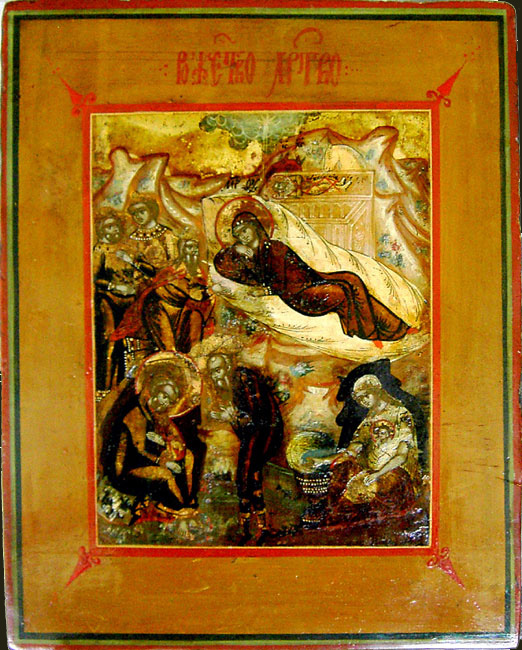 THE BIRTH OF CHRIST
THE BIRTH OF CHRIST
Item number: 204
Tempera on wood
27.5 x 21 cm
Russia, 17th century
sold
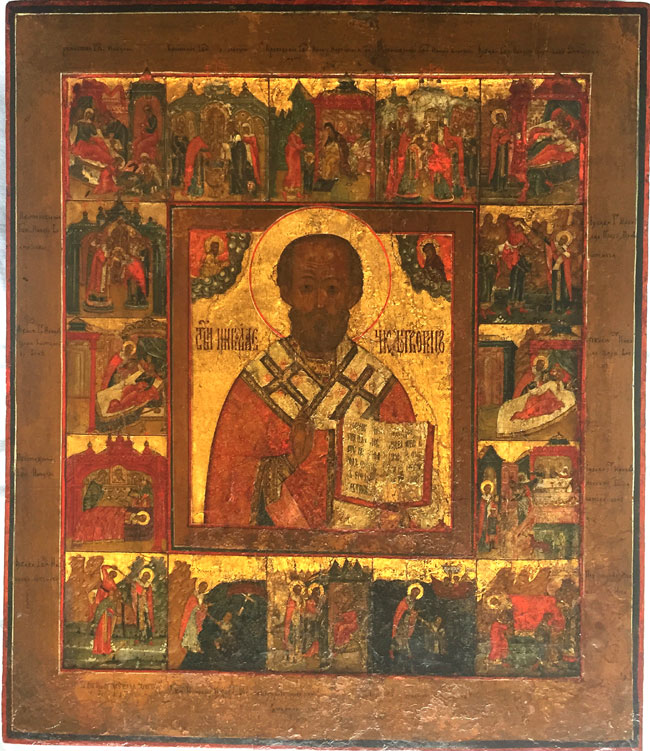 ST. NICHOLAS VITA
ST. NICHOLAS VITA
Item number: 379
Tempera on wood, gold ground
56 x 46 cmRussia, 18th century
 MOTHER OF GOD, COMFORT OF THE SUFFERING
MOTHER OF GOD, COMFORT OF THE SUFFERING
Item number: 357
Tempera on wood,
18 x 14 cm
Russia, 19th century
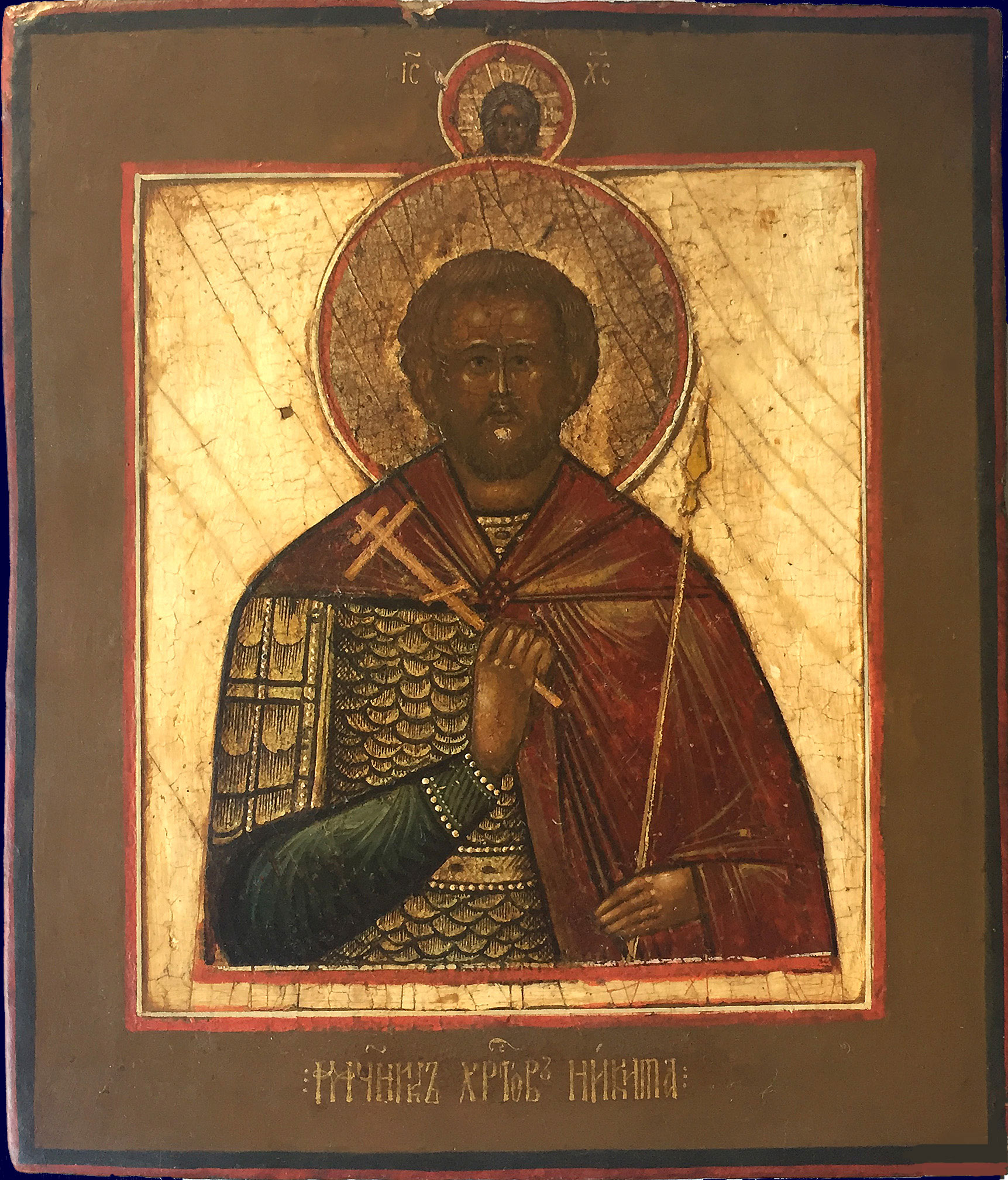 SAINT NIKITA
SAINT NIKITA
Item number: 356
Tempera on wood
18 x 14 cm
Russia, 19th century
 CHRISTUS PANTOCRATOR
CHRISTUS PANTOCRATOR
Item number: 319
Tempera on wood
35 x 30 cm
Russia, 19th century
Christ Pantocrator – the ruler of the world – is depicted in half-length. His right hand is raised in a gesture of blessing, while in his left hand he holds the open Gospel book.
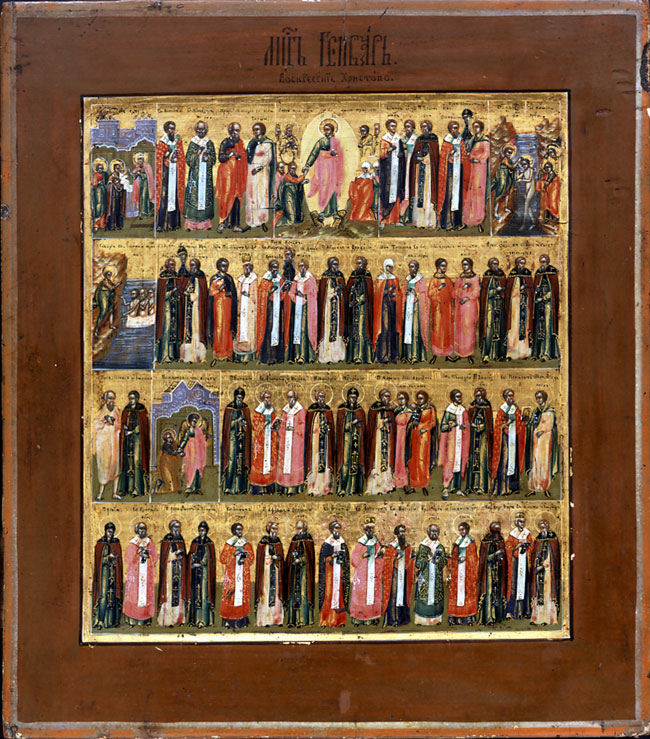 CALENDAR ICON JANUARY
CALENDAR ICON JANUARY
Item number: 74
Tempera on wood, gold ground
35.5 x 31.5 cm
Russia, 19th century
Depicted are the saints and feasts of the month of January.
 DECAPITATION OF ST. JOHN
DECAPITATION OF ST. JOHN
Item number: 417
Tempera on wood
31 x 26.5 cm
Russia, 19th century
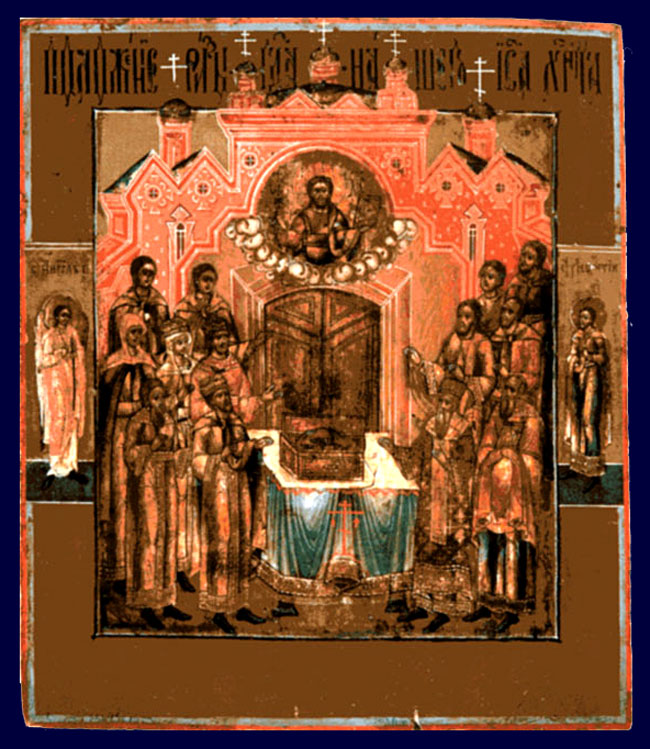 THE DEPOSITION OF CHRIST'S GARMENT
THE DEPOSITION OF CHRIST'S GARMENT
Item number: 279
Tempera on wood
30.5 x 26 cm
Russia, 19th centuryThe Gospel of John recounts how the soldiers divided Christ’s clothes among themselves, but cast lots for the single-piece undergarment. The four pieces of the outer garment were given as a gift to Russian Tsar Michael Feodorovich and Patriarch Filaret in Moscow by Shah Abbas I at the beginning of the 17th century. The Russian Orthodox Church celebrates the deposition of this relic in Moscow on July 10. According to legend, the Holy Robe was found by St. Helena during her pilgrimage to Jerusalem and given by her as a gift to the Bishop of Trier, where it was enclosed in the altar of the cathedral.
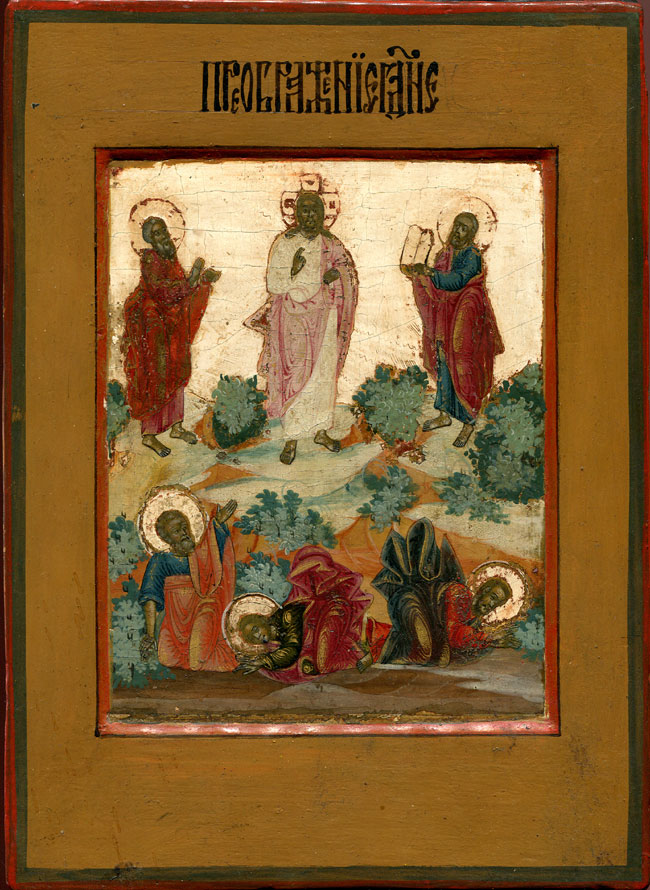 THE TRANSFIGURATION
THE TRANSFIGURATION
Item number: 202
Tempera on wood
24.4 x 17.8 cm
Russia, 19th century
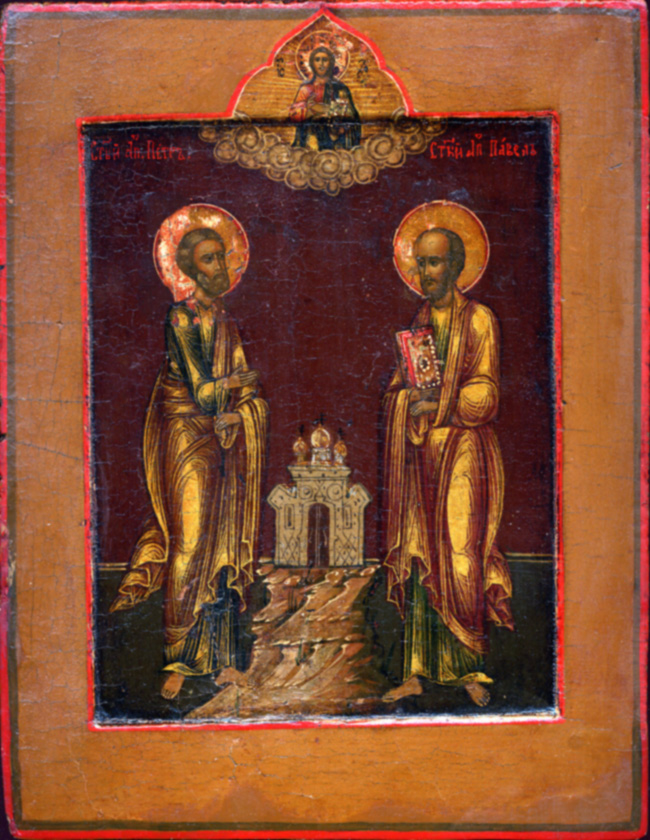 APOSTLES PETER AND PAUL
APOSTLES PETER AND PAUL
Item number: 138
Tempera on wood
22 x 17 cm
Russia, 19th century
 THE BEHEADING OF ST. JOHN THE BAPTIST
THE BEHEADING OF ST. JOHN THE BAPTIST
Item number: 315
Tempera on wood
20.5 x 16 cm
Russia, 19th century
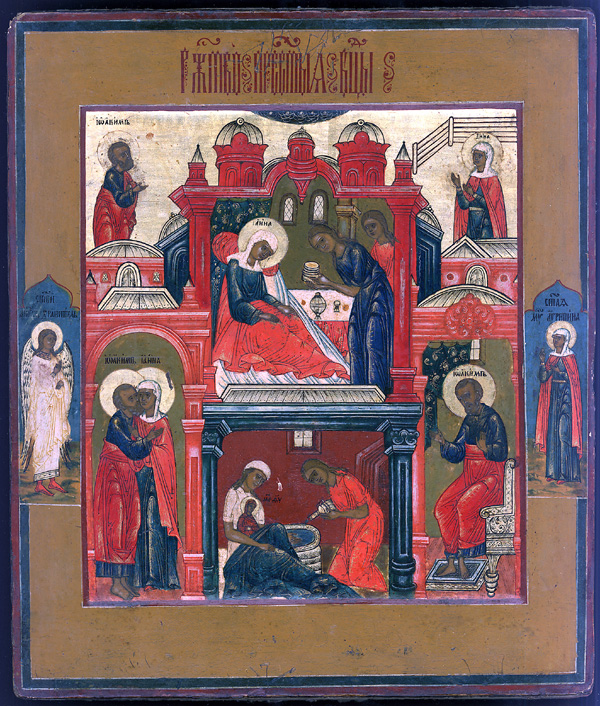 THE BIRTH OF THE VIRGIN MARY
THE BIRTH OF THE VIRGIN MARY
Item number: 135
Tempera on wood, gold ground
31.8 x 27.5 cm
Russia, 19th century
The story of the incarnation of the divine word was initiated by the birth of the Mother of God. Ancient and late antique maternity pictures served as iconographic models for this theme, which arose from the depiction of the birth of Christ.
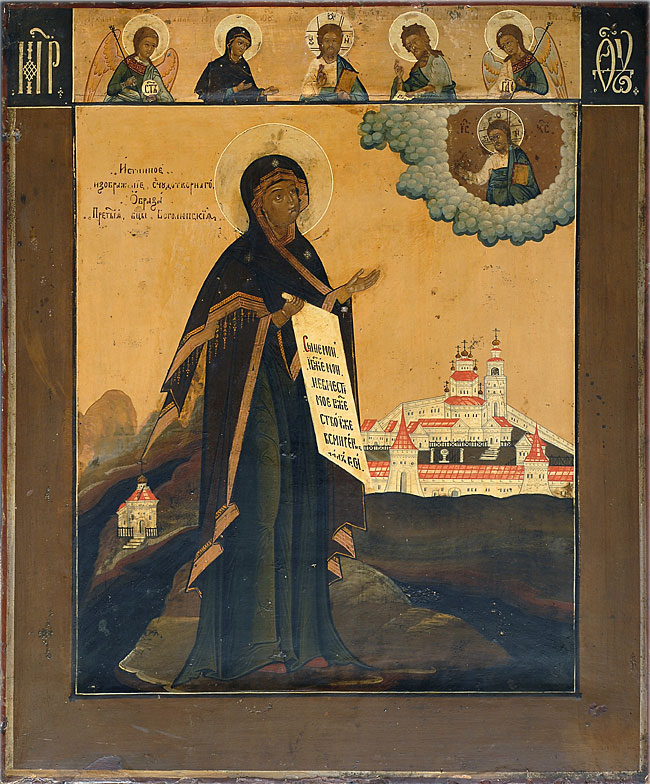
 Mother of God Bogolubskaya
Mother of God Bogolubskaya
Item number: 57
Tempera on wood
53.5 x 44.5 cm
Russia, 19th century
According to legend, the Mother of God appeared to Prince Bogolyubov and instructed him to build a monastery. The prince did so and also had an icon of Mary painted according to his vision. The Mother of God stands on the left side of the painting and looks up at Christ, who is floating in the upper right corner of the painting. Her left hand is raised in prayer, and in her right hand she holds an open scroll with a prayer. In the background, you can see the monastery, and the upper edge of the painting depicts the extended Deesis.
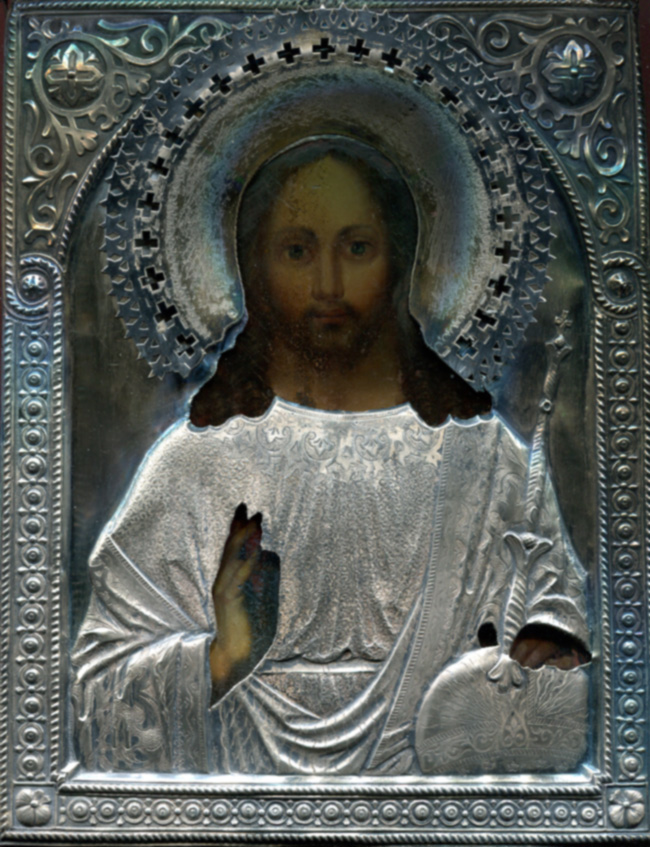 CHTRISTUS PANTOCRATOR
CHTRISTUS PANTOCRATOR
Item number: 247
Tempera on wood
22 x 17.5 cm
Russia, late 19th century
Oklad Silver, Moscow 1898-1908
 SAINT NICHOLAS
SAINT NICHOLAS
Item number: 248
Tempera on wood
22 x 17.5 cm
Russia, second half of the 19th century
Oklad Silver, Moscow 1868
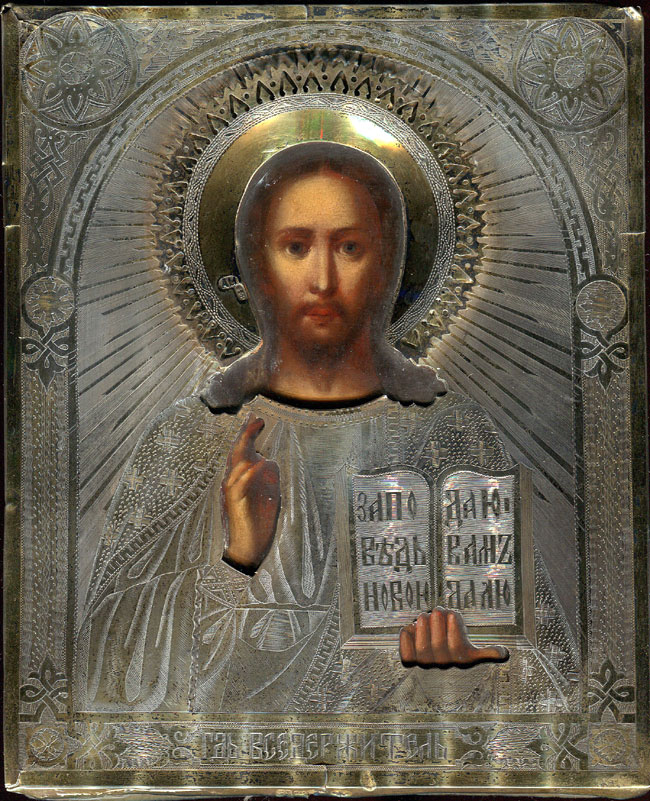 CHRISTUS PANTOCRATOR
CHRISTUS PANTOCRATOR
Item number: 93
Tempera on wood
22 x 17.5 cm
Russia, second half of the 19th century
Oklad Silver, Moscow 1876
M.M. Alexander Muchin
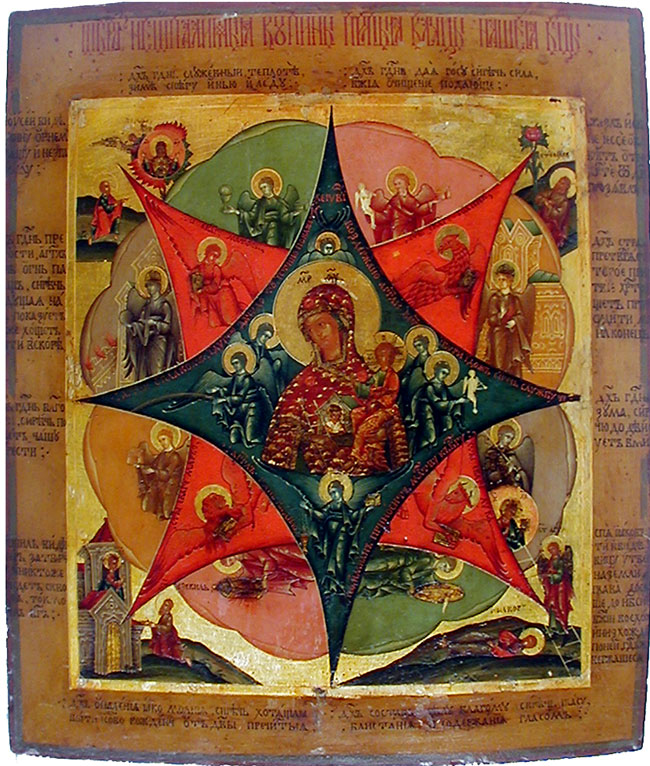
 Mother of God of the Non-Burning Bush
Mother of God of the Non-Burning Bush
Item number: 98
Tempera on wood, gold ground
31.5 x 27.5 cm
Russia, 19th century
The theme of the icon comes from a hymn in which the Mother of God is compared to the unburnable thorn bush that Moses saw on Mount Horeb.
In the center of a four-pointed star, the Mother of God is depicted with the Christ Child as Immanuel and Christ the King. In another red star below, the symbols of the four evangelists—Mark, Matthew, Luke, and John—are depicted. Around them, angels with Akathistos symbols are shown on clouds. In the four corners of the image are the saints Isaiah, Ezekiel, Jacob, and Moses.
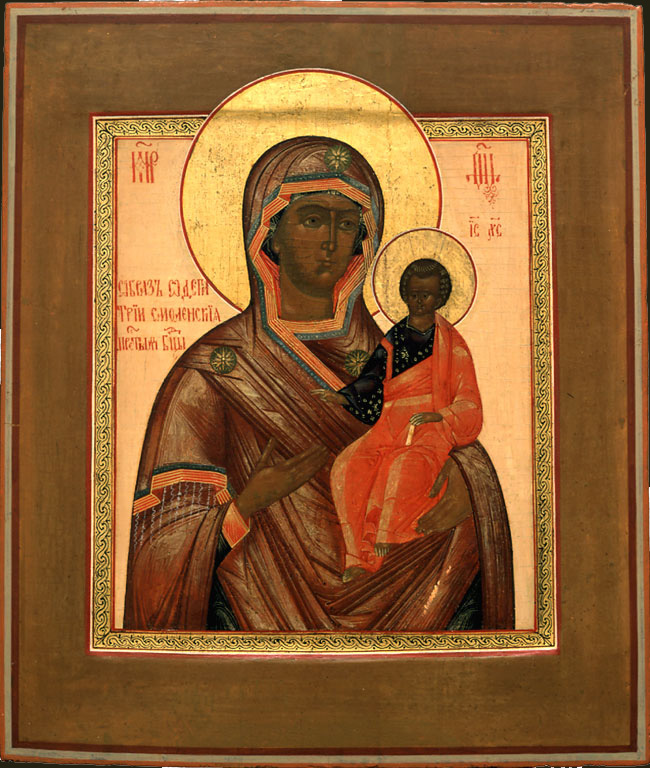 VIRGIN OF SMOLENSK
VIRGIN OF SMOLENSK
Item number: 116id
Egg tempera on wood
35 x 30 cm
Russia, Mstera, 19th centuryThe Smolensk Mother of God belongs to the Hodigitria type of Mother of God, the majestic “way-showing, way-leading” representation of Mary. According to legend, the Greek princess Anna brought this type of Mother of God from Byzantium to Russia on the occasion of her marriage to a Russian grand prince.
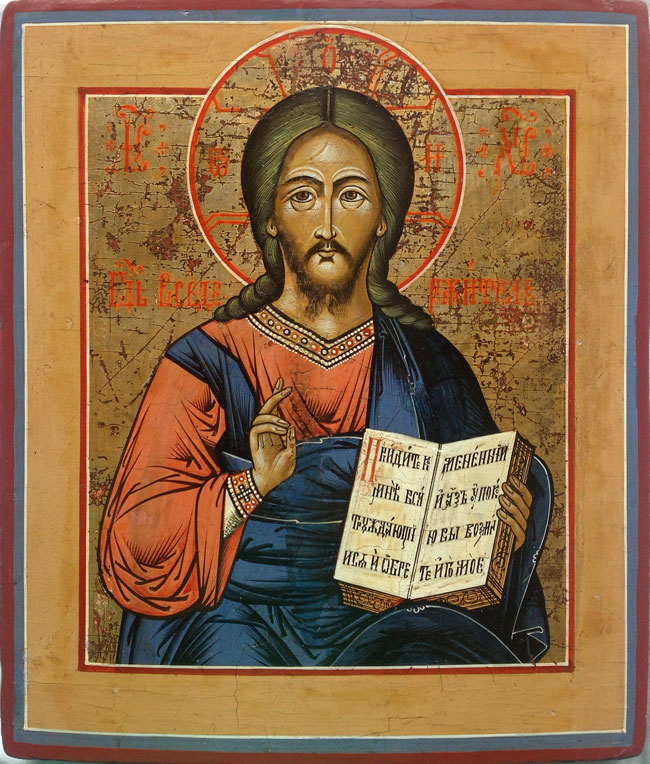 CHRISTUS PANTOCRATOR
CHRISTUS PANTOCRATOR
Item number: 329
Tempera on wood, gold ground
35.5 x 31 cm
Russia, 19th century
 Mother of god from KASAN
Mother of god from KASAN
Item number: 249
Tempera on wood
26 x 21 cm
Russia, 19th centuryAfter the Mother of God appeared to a 9-year-old girl, the Kazanskaya icon was found in Kazan in 1579. It was carried in a solemn procession to the Cathedral of the Annunciation, where it healed numerous blind people.
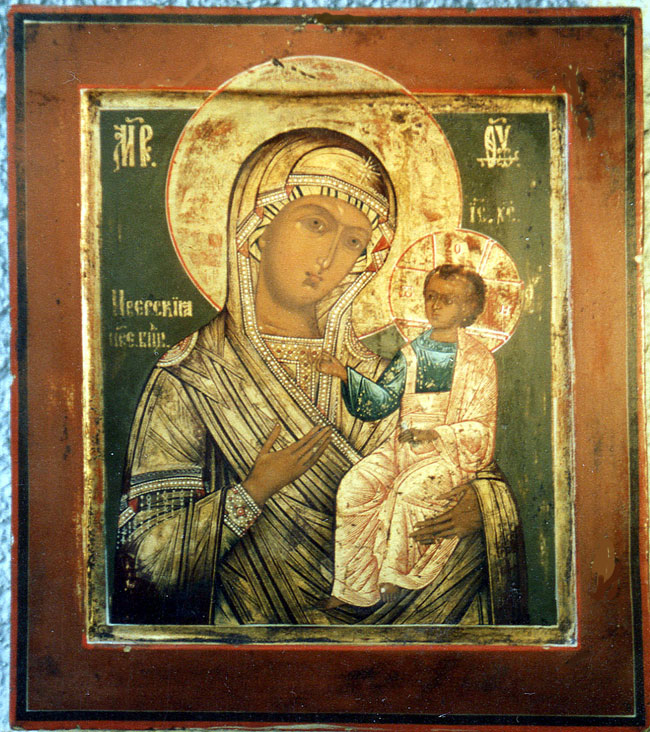 Mother of God Iverskaya
Mother of God Iverskaya
Item number: 403
Tempera on wood
31 x 26.5 cm
Russia, 19th centuryAccording to legend, during the Iconoclastic Controversy in Byzantium in the 9th century, a devout widow from Nicaea hid the icon in her home. After it was discovered by the emperor’s iconoclastic spies, she cast the image into the sea, where it floated upright. Many years later, the icon appeared in a pillar of fire off the coast of the Iviron Monastery on Mount Athos, where it was retrieved from the sea by a hermit and a church was built for it by the monks of the monastery.
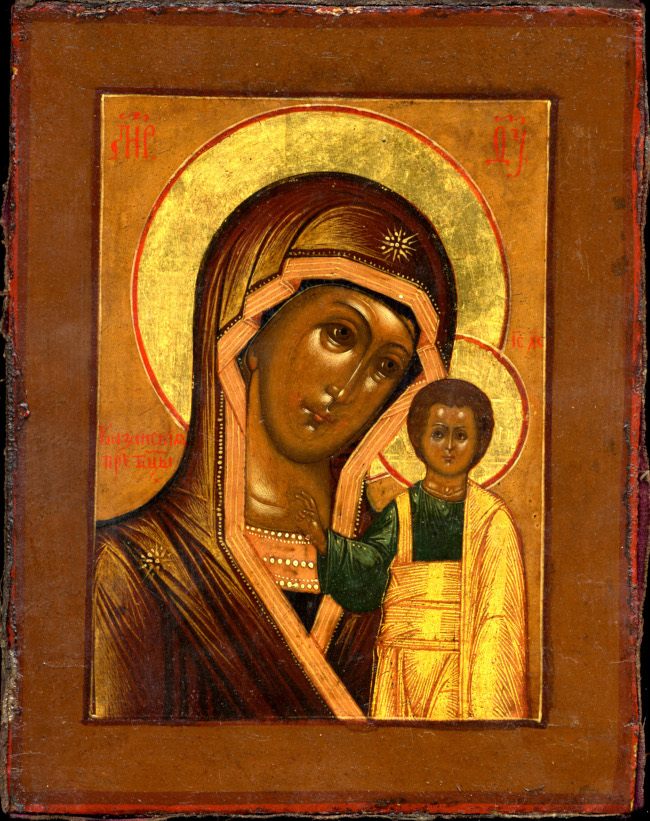 VIRGIN OF KASAN
VIRGIN OF KASAN
Item number: 115
Tempera on wood
22.3 x 17.6 cm
Russia, 19th century Mother of God Fedorovskaya
Mother of God Fedorovskaya
Item number: 406
Tempera on wood
36 x 32 cm
Russia, 19th centuryAccording to legend, the miracle of the apparition of the Mother of God Fedorovskaya to Kostroma took place in 1239. The miraculously found image was placed in the local cathedral. It accompanied Prince Vasily and his army in their victorious battle against the Tartars.
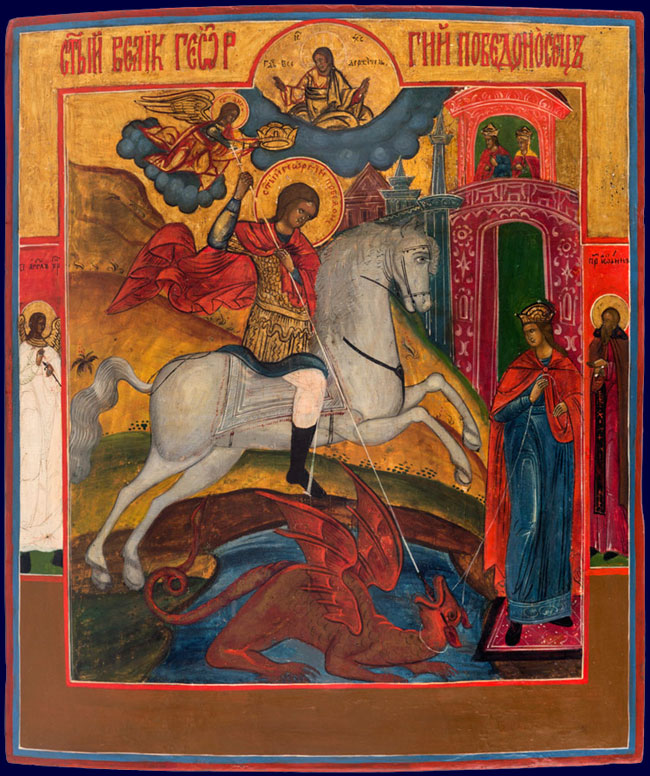 SAINT GEORGE
SAINT GEORGE
Item number: 435
Tempera on wood
45 x 38 cm
Russia, 19th centuryThe saint came from Cappadocia and achieved high honors in military service under Diocletian. After his conversion to Christianity, he suffered martyrdom and was beheaded. George is the fighter against evil and the victor over the enemy, who appears in various forms (dragon, snake).
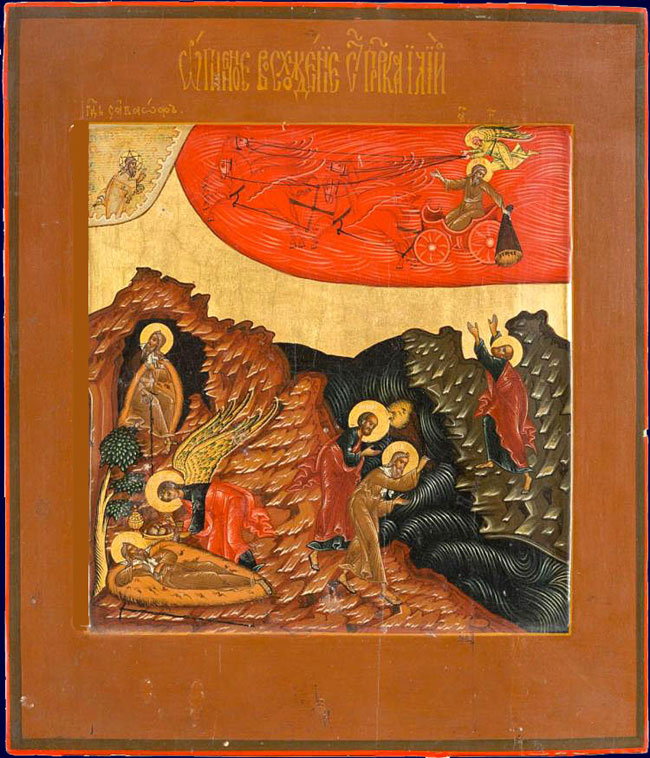 SAINT ELIAS
SAINT ELIAS
Item number: 440
Tempera on wood, gold ground
35.5 x 31 cm
Russia, 19th centuryIn the upper part of the picture, the prophet Elijah can be seen riding toward heaven in a chariot drawn by winged horses, carried by an angel in a ball of fire. He throws his cloak to Elisha, who is standing below him against a rocky background. In the lower left part of the picture, Elijah is awakened by an angel, above which the saint is fed by a raven. In the lower center, the prophet, accompanied by his disciple Elisha, strikes the waters of the Jordan with his cloak, which then part so that the saint can cross dry-footed.
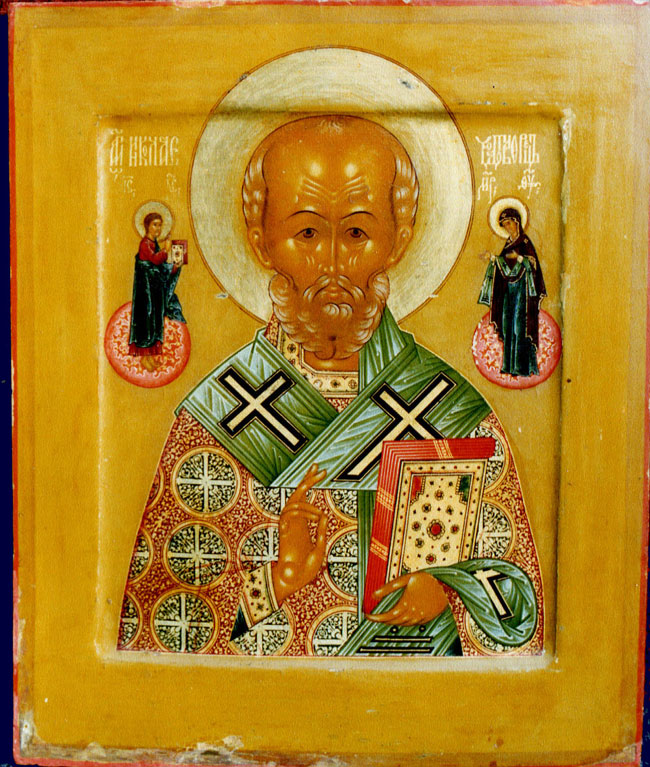 SAINT NICHOLAS
SAINT NICHOLAS
Item number: 410
Tempera on wood
31 x 26.5 cm
Russia, around 1800Saint Nicholas, bishop of Myra in the 6th century and the most popular saint of the Eastern Church, is depicted in the traditional manner as a half-length figure in archbishop’s robes. In his left hand he holds the closed Gospel book, his right hand is raised in a gesture of blessing.
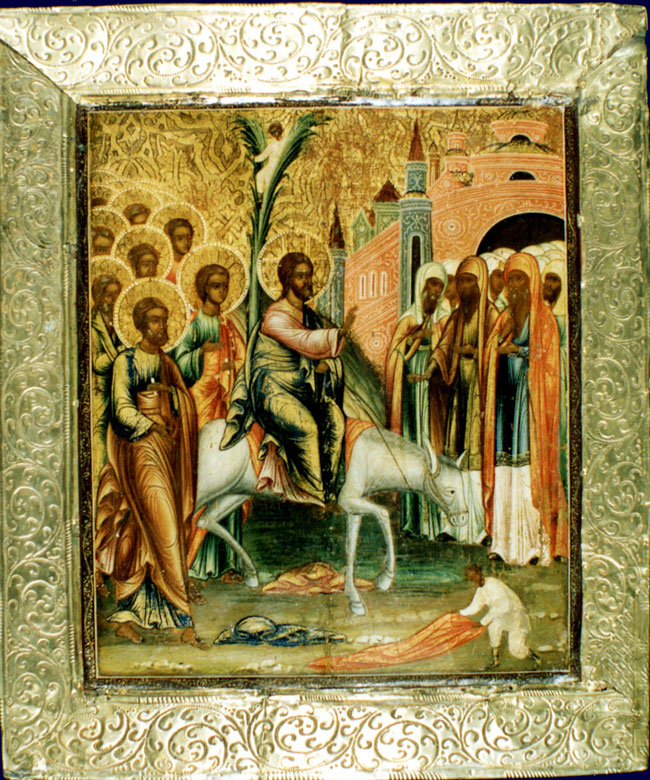 ENTRY INTO JERUSALEM
ENTRY INTO JERUSALEM
Item number: 411
Tempera on wood, brass base
37.4 x 32 cm
Russia, 19th centuryThe entry into Jerusalem marks the beginning of the Passion cycle of the Lord. Christ rides toward Jerusalem on a white donkey, followed by the apostles. The people pour out of the city gate to cheer him. In the background, the Mount of Olives rises on the left, in the center the palm tree from which the children take branches to welcome the Lord, on the right Jerusalem and architecture symbolizing the temple.
 THE BAPTISM OF CHRIST
THE BAPTISM OF CHRIST
Item number: 416
Tempera on wood
31.5 x 27 cm
Russia, 19th centuryAgainst a rocky background, St. John is depicted on the left side of the painting, baptizing Christ standing in the waters of the Jordan River. Above Christ’s head, the Holy Spirit hovers in the form of a dove. On the right side of the painting, three angels with veiled hands appear, symbolically representing the angelic hierarchies.
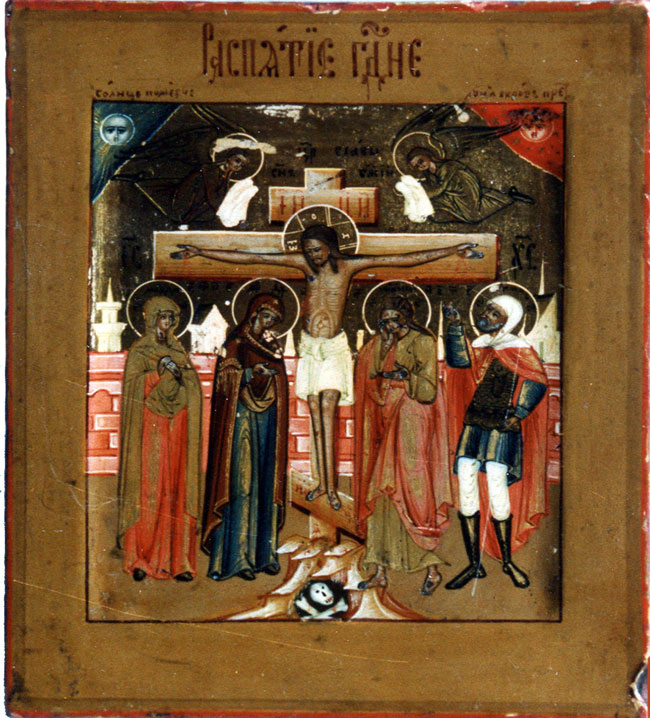 THE CRUCIFIXION
THE CRUCIFIXION
Item number: 429
Tempera on wood
12.5 x 10.5 cm
Russia, 19th century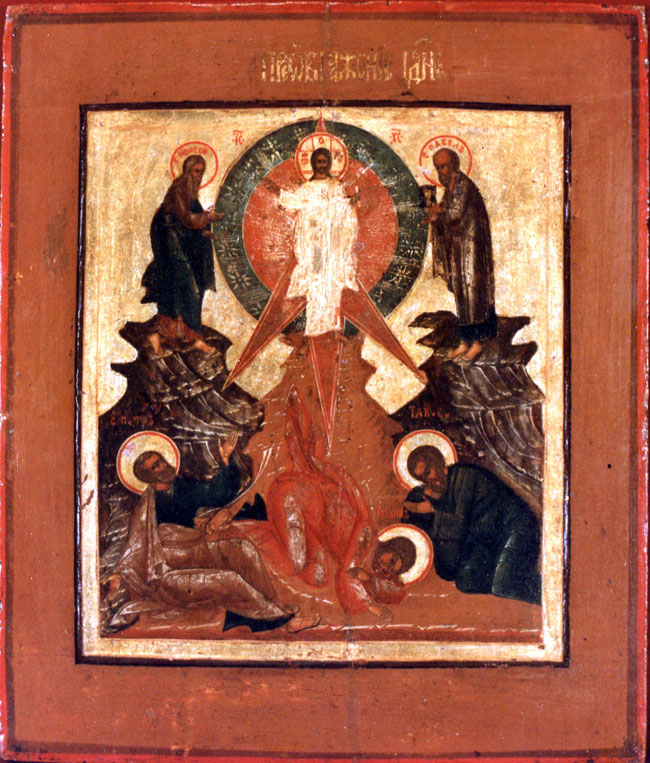 TRANSFIGURATION ON MOUNT TABOR
TRANSFIGURATION ON MOUNT TABOR
Item number: 418
Tempera on wood
31.4 x 27 cm
Russia, 19th century
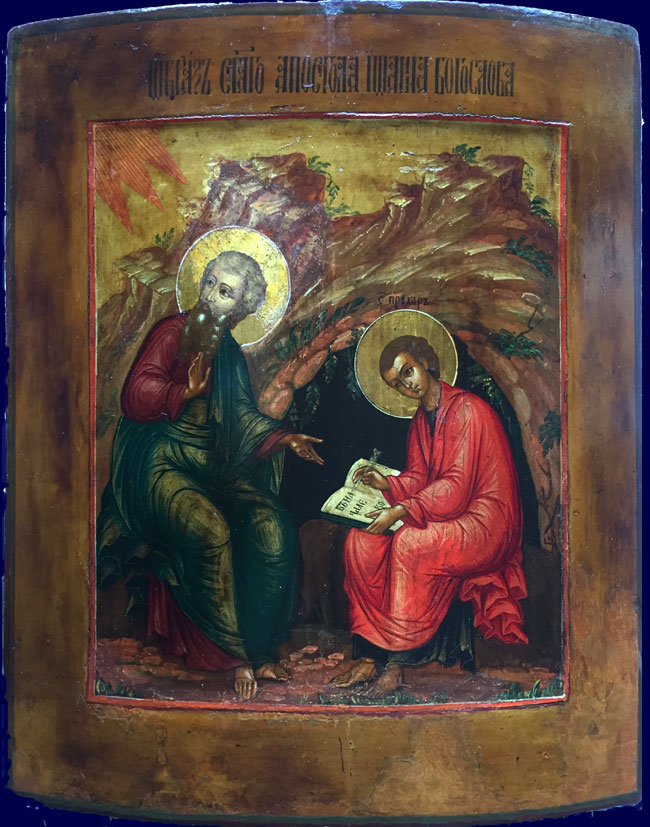 EVANGELIST ST. JOHN
EVANGELIST ST. JOHN
Item number: 420
Tempera on wood
34.5 x 29.5 cm
Russia, 18th centurySaint John the Evangelist dictates the Gospel to his disciple Prochorus.
 Mother of God Pokrov
Mother of God Pokrov
Item number: 424
Tempera on wood
22.2 x 17.8 cm
Russia, 19th centuryThe origin of this depiction of Mary probably goes back to the miracle of the veil in the Blachernae Church in Constantinople. According to legend, Andrew, a fool for Christ, and his disciple Epiphanius had a vision in which the Mother of God spread her maphorion over the people as a protective cloth. The lower part of the painting depicts the singer Romanos, whose feast day is celebrated on the same day as that of the Mother of God Pokrov.
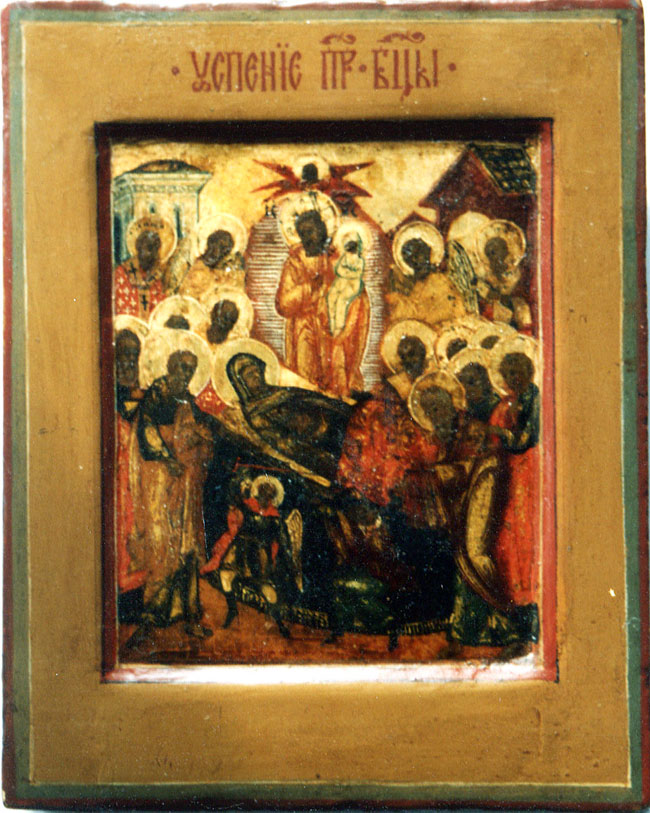 THE DEPARTURE OF THE MOTHER OF GOD
THE DEPARTURE OF THE MOTHER OF GOD
Item number: 430
Tempera on wood
15 x 12 cm
Russia, 19th centuryThe main feast of the Virgin Mary is known in the East as “The Dormition of the Mother of God” and in the West as “The Assumption of Mary.” The Mother of God lies flat on her deathbed, surrounded by the mourning apostles. Behind the bier, in a mandorla, stands Christ, holding the soul of the Mother of God in the form of a child dressed in white.
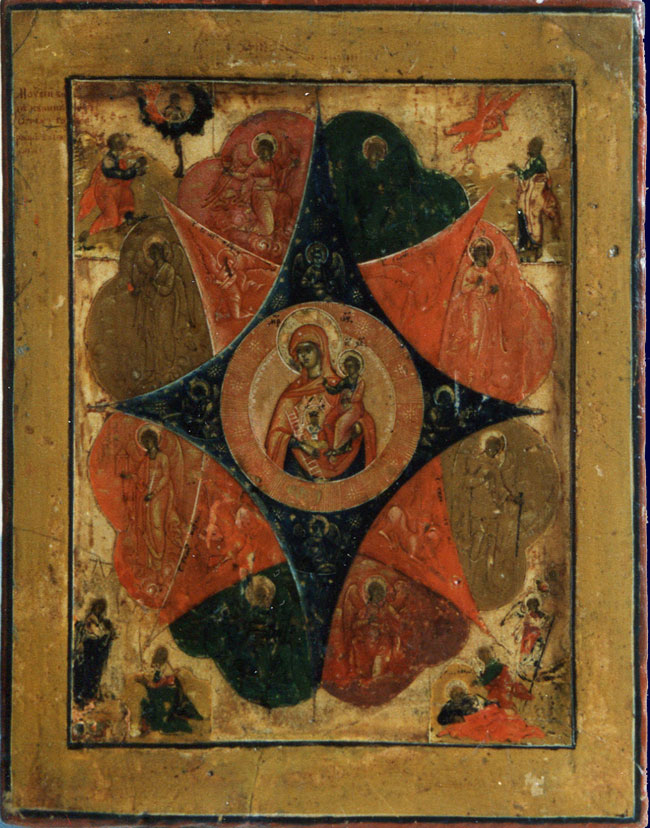 Mother of God of the Non-Burning Bush
Mother of God of the Non-Burning Bush
Item number: 425
Tempera on wood
17.8 x 14.5 cm
Russia, 19th centuryIn the center of a four-pointed star, the Mother of God is depicted with the Child as Emmanuel and Christ the King. In another red star below, the symbols of the four evangelists—Mark, Matthew, Luke, and John—are depicted. Around them, angels with Akathistos symbols are shown on clouds. In the four corners of the picture are the saints Isaiah, Ezekiel, James, and Moses.